In recent months, we’ve seen the rise of independent social media marketed toward authenticity: first BeReal, now others like Gas have cropped up. When we speak with Gen Z consumers, authenticity feels like a buzzword—it comes up again and again as a guidepost for ideal experiences—yet, they have difficulty defining it. Instead, it feels like a reaction to the inauthenticity they see on Instagram and to a lesser extent TikTok, which they see as to blame for feeling a lack of social connection in spaces we believe should foster connection. While BeReal’s features limit the ability to curate posts, the core of its UX is the same as larger social media platforms, which limits the social connection that underpins authenticity. To design for authenticity, platforms must adopt a UX that allows users to adapt and evolve their identities over time.

Putting on an “act” in social spaces isn’t unique to social media. In 1959, Erving Goffman published The Presentation of Self in Everyday Life, where he contends that real-life social situations cause participants to be actors on a stage, with each implicitly knowing their role. The character one plays depends on a variety of contextual factors: who is present, the “props” and “set” (visual cues) among others. As such, each performance is different. His theory explains why one might feel awkward when two different social groups are in the same room: the actor doesn’t know which role they are supposed to play.

In online spaces, the feed is our perma-stage. Facebook’s News Feed was designed to deliver updates on friends the same way we receive updates on local and national news. It seems inevitable that this product vision would produce performances, and highly curated ones at that. Its one-to-many nature limits standard interaction; instead of an actor-actor dynamic, we see a creator-commentor-lurker hierarchy. And because creators design their posts to cater to the masses, they are not moving from stage to stage; instead, one’s online persona feels static. Here, the light of inauthenticity shines through, as we are no longer playing together, but watching others perform.

In Goffman’s model, actors retreat “back-stage” when they are alone or with close others — this is the place where they can let their hair down and be free from keeping up impressions. While the dominance of social media’s feed might make the Internet seem like an unlikely place for back-stage settings, we find almost every social media has a direct message function. In contrast to the one-to-many, post-centric UX of the feed, these back-stage spaces are one-to-one or one-to-few interaction-heavy spaces that have come to be the most fulfilling part of the social media experience for users. Instead of solo “lurking” that can lead to comparison and loneliness, users that are active in back channels find engagement, connection, and reprieve to be themselves, or at least the character that feels like the smallest margin of performance with this particular friend or group, since they have created their “show” together.

But it’s the feed that dominates the social media experience. It permeates moments that would have traditionally been back-stage settings (for example, alone in one’s home), and so we find ourselves wanting authenticity, or a back-stage feeling, here. And so, trends like posting crying selfies have surfaced, which feel close to a cut and paste: back-stage content onto the front-stage. While a post like this could make a user feel understood or less alone momentarily, the infrastructure on social media doesn’t enable the interaction needed to produce real support, and can continue to feel designed for likes. Between glamour shots and crying selfies sits BeReal, where users post more of the “everyday” of their everyday life. Still, BeReal has been criticized for either being boring, still performative, or even exclusive in a more intimate way. A feed can’t support true connection, the table-stakes of enduring authenticity.

Outside of these two paradigms, we see a third type of space emerging. Platforms like Discord have taken hold during the pandemic as a more casual place to “hang out” virtually. Building on a chat-based UX, Discord enables users to find others with similar interests and move between smaller and larger channels as well as text and voice-based communication. Further, Discord is the hub for creative expressions like Midjourney, an AI image generator that can only be accessed through Discord using bot commands. Similarly, Fortnite builds conversation through shared experience and play, in so doing re-leveling the audience-observer dynamic and putting engagement over performance. Extending Goffman’s metaphor, we might compare the social atmosphere created on Discord and Fortnite to a writer’s room, where users engage and create together. 

A more agile space like Discord reflects the “Presentation of Self” as charted by Gen Z. This generation sees the self as a canvas for experimentation, where identity is fluid. Through creative tools and less definite spaces, creativity and play  extend to the making of self on a journey of self-discovery. Users can create and try on characters much like a comedian might on a Tuesday night, to first see if it might resonate for Saturday night, much before an enduring part of the act.

To enable more dynamic interactions , we will need to move away from a cut and paste UX approach to a ground-up infrastructure that is designed for fluidity. Taking pointers from the “writer’s room,” two principles can guide us. First, collaboration. Similar to “yes – and,” creators in authentic spaces create in tandem vs. a creator-consumer dynamic. UX of authentic spaces must lean toward chat over post, which fosters interaction and relationships that ensure it’s safe to try a new presentation of self. Second, authentic social media needs impermanence. Though a feed may refresh over time, we know that posts on Instagram will be connected to our profile for years to come. If it’s instead lost in a Discord feed, we may feel more freedom to experiment and “get it wrong.” Combining collaboration and impermanence, we might just set the stage to permit the collection of characters we all play, so that we can all feel a bit more dynamic, and perhaps even authentic, in digital spaces.

Exploring how AI lives in the past and dreams of the future


As I drift online, I’m becoming more aware of AI’s presence. When I browse the web, design a prototype, or debate what to cook for dinner it’s becoming more uncertain what my next move should be. Should I invite AI into my thinking process? 

I find myself in a storm of cool AI products with murky ethics and big promises for a more personalized experience. When the thunder roars, we don’t have the option to hide indoors. How do we coexist with this AI hype in our work and personal lives?

AI changes how we create

Over the decades, digital technology has pushed us to reconsider our processes and collective values. AI-powered features are rolling out into everyday consumer products like Spotify, Notion, and Bing at lightning speed. It strikes us with delight, intrigue, and fear. Finally, we have tools that can shower our thoughts with attention deceivingly well. You ask and shall receive a dynamic and thoughtful response as an audio, code, image, text, or video output. 

The leap from spell check to ChatGPT’s ability to rewrite paragraphs in “Shakespearean dialect” lands us with new questions of what deserves our attention and praise. Should we devalue an article written with the help of Notion AI? Is artwork generated by LensaiAI less precious than a hand-drawn painting by a local artist?

AI is making us rethink our values in similar ways as the anti-art movement

In the early 1900s, the anti-art movement was led by artists who purposely rejected prior definitions of what art is. It provoked a shift in what we value in the art world. During 1917, the French artist Marcel Duchamp submitted a store-bought urinal signed with the pseudonym “R. Mutt” to a gallery show. The submission was rejected and caused an uproar, but it expanded and confronted our imagination of what is considered art. 

This created opportunities for new forms of art that go beyond the institutional vantage point of the artist. Rather than focusing on the craft and sublimity of a physical artwork, anti-art paved the way for contemporary art that values the ideas and concepts being explored by the artist in dynamic ways like performance, video, sculpture, and installations.

Generative AI is becoming the Marcel Duchamp of our 21st century. Similar to the anti-art movement, AI invites us to reject conventional tools, processes, and products. It allures us by freeing us from being alone with our thoughts and concisely telling us what to imagine. The invitation of an AI companion in our classroom, office, or home allows for us to speed up, cut in half, or eliminate our thinking process. This challenges our sense of self and our place in the world. 

AI intensifies the blurring of the line between what is human and what is artificial

As a result of AI changing how we create, what we’re creating is also changing. The AI hype is taking storm in digital spaces where democratization of user privacy and autonomy is dwindling. For example, Twitter and Meta launched a paid product version that grants additional verification and visibility features. This increases the chance for misinformation, fake profiles, trolls, and bots. With AI intensifying the blurring of what is human and what is artificial, the need for authentication and transparency continues.

Vogue covered the fascination behind the viral hyper-real “big red boots” by MSCHF that resemble the pair Astro Boy wears in the anime series. These impractical, playful boots blur the line between the real and the unreal in similar ways as AI does. It plays into the double take we do while listening to the AI-powered DJ on Spotify or scrolling across the viral AI-generated image of Pope Francis in a white puffer. The uncanny quality of the big red boots force us to consider how digital aestheticization distorts details, realism, and quality. A stark contrast is made between what exists in the real world and what is trying to fit in. The boots make it obvious what qualities of the imperfect physical world can’t be digitally copied over.

Our presence gives value to AI outputs in a variety of ways

The shift of creativity in the age of AI also means world-building and dreaming with tools that are not independent nor neutral. In an article by CityLab, the architectural designer Tim Fu describes the AI art generator Midjourney as an advanced tool that can aid the creative process but “still requires the control and the artistry of the person using it.” The rapidly generated images help with the earliest stages of a project, but the images lack detail. The architects spot gaps in the AI art generator’s understanding of non-Western architecture.

In a recent NYT guest essay, Noam Chomsky describes how ChatGPT “either overgenerates (producing both truths and falsehoods, endorsing ethical and unethical decisions alike) or undergenerates (exhibiting noncommitment to any decisions and indifference to consequences).” Rather than a bot takeover, our responsibilities will expand in new ways as designers, programmers, educators, students, or casual users. We must create a new type of digital literacy to address this tension between the user and AI of knowing what to ask, how to push back, and when to accept an outcome. 

By making these digital experiences with AI more collaborative, we can collectively anticipate blindspots. LinkedIn recently introduced a new feature called “collaborative articles” that starts with a pre-written article by AI. Experts on their platform with relevant skills based on their internal evaluation criteria are invited to add context and information. It uses AI as a jumping off point for discussion that emulates the back-and-forth that happens in comment sections. This is one approach for more human intervention that creates space for our live cynicism and voice to be at the core of any AI output.

Together with our skepticism and presence can we prevent the distortion of our ideas. This puts necessary pressure on the in-between moments that shape who we are. The moments when we are alone with our thoughts—without the distraction of technology.

You don’t need AI to dream big

AI lives in the past and dreams of the future. Rather than engaging in the present moment, AI takes any context and uses training data to predict what comes next in the sequence. Instead of sieving through the excess of information on the Web, we get information rearranged from large language models that don’t leave a clear trace of how it ended up where it did. ChatGPT creates a foggy interpolation of the Web.

Digital technology distorts our understanding of linear time by repackaging the past as a future possibility. Our senses are grounded in the real world and in the present, where we truly exist beyond data points. If we treat AI as the end-all-be-all for creativity, learning, productivity, and innovation, won’t we lose our sense of self and what we stand for? Generative AI exists for your text input; it lives to anticipate but doesn’t live.

Illustration by Marine Au Yeung

Recently, an article on Fast Company made the announcement that corporate America broke up with design, citing that companies who were once green with Apple-envy and hungry for transformation are now jaded after realizing that “design is rarely the thing that determines whether something succeeds in the market.” Add in the recent corporate silence on the topic of design, and rumors abound – apparently design and corporate America are in trouble.

But does this really mean the relationship has fizzled out? Or could it instead be a time for reflection, re-evaluation, and evolution? Three of our Design and Strategy Directors respond to these questions and more –

Corporate America didn’t break up with design. It broke up with the mythological promise design firms sold them.

Jeff Turkelson, Strategy Director

‘Design will allow you to disrupt, transform, create and lead industries. Just do some research, run some workshops with sticky notes, prototype, and you’ll be onto  something that no one else could dream of!’

These are the false promises that corporate America has broken up with. But, there were always dissenters, Don Norman himself said it:

“Design research is great when it comes to improving existing product categories but essentially useless when it comes to new, innovative breakthroughs.”

Flash forward to today, and the hype around being a design-led organization is pretty much dead. But corporate America has embraced design in a more traditional sense—significantly expanding internal design teams—not to think of radical breakthroughs but to create good user experiences that are usable and delightful.

It’s in many ways a reversion back to the decades-old paradigm of user-centered design (though often twisted by profit incentives, e.g. designing to maximize engagement or conversion rates rather than truly serve the user).

However, the spirit of human-centered design (HCD) is not lost. It has evolved. While the idea of being a “design-led” organization has lost its allure and most in-house practitioners are focused on traditional craft, design’s value to business was always secondary to the value designers sought to bring to humans. And for perhaps largely external reasons, many corporations have begun to embrace HCD’s value-based themes: designing for accessibility, inclusion, equity, etc.

Here we see design intersect with the responsible technology movement— designers, technologists, activists, and more, seeking to create positive outcomes or at least mitigate harms. Designers don’t get to say they own this broader movement but they do play an important role in its evolution.

What goes in comes out: amplify design’s value by doing these four things.

Chad Hall, Design Director

Companies green with “Apple envy” may have invested billions of dollars in design, but few did it well, and most in a way vastly different from the design-centric companies they looked up to. Here are four easy to overlook things they could do to better gain value from design.

1. Understand the complexity of problem spaces

“Simplicity and complexity need each other,” (John Maeda), a.k.a. there can be no simplicity without complexity. Designers work hard to obfuscate the complexity that exists in the products, services, strategies, and processes we work on. Understanding and allowing time and space to work through these complexities is paramount. If designers or companies don’t understand the complexities of what they work on and invest the time and resources to make sense of it, they’ll never be able to simplify anything down into a ‘magical solution.’

2. Foster seamless interdisciplinary collaboration

Design works best when not in a vacuum. Too often, I see these situations that prevent seamless experiences: A product team separated from key decision makers; A care team that doesn’t have good insight into their patient’s experience; An education board that is far removed from the students and communities it aims to impact.

Seamless customer experiences are a product of seamless interdisciplinary collaboration. Working alongside an interdisciplinary team with deep understandings of different industries, domains, processes, or organizations at hand, designers become experts in not only crafting forms, but leveraging their knowledge to become experts in facilitating processes. 

3. Align power and incentives with desired outcomes

If companies want transformation, they need to examine their internal power and incentives structures. It’s not enough to have a vision. Fragmented teams and inequitable power in decision making yield products with poor outcomes.

To make seamless experiences, the customer experience must be singular above internal organizational divisions, product categories, and even earnings reports in some cases. The organization and culture must support this collaboration; allowing, motivating, and empowering employees to make decisions that work toward the shared goal of a seamless customer experience. Rather we often see internal competition, tailoring outcomes to please a HiPPO (Highest Paid Person’s Opinion), or misaligned performance measurements that incentivize personal decisions over preferable product outcomes. While most organizations might have the vision, they don’t align the distribution of power and incentives to get the outcomes they seek.


4. Be curious about the unknown

Many companies have implemented design in a risk-averse way. Expecting transformation without accepting a level of risk leads to disappointment. To curb risk, we’ve turned a designer’s intuition and mastery of skills into a scalable and repeatable process built upon the scientific method. Design Thinking and Human-Centered Design have proliferated. These are great at identifying existing pain points and undiscovered needs, but lend toward refining existing solutions through incremental improvements. This has merit and need in products today. But, it’s not going to rock the boat.

To make large leaps, we must allow imagination and intuition back into the process. Designer’s, through years of mastery, are primed to make unexpected connections that can lead to new innovations. But, this process is nearly impossible to evaluate and scale. It pushes us into the unknown future and to rely somewhat on intuition. In our data-driven world, this is uncomfortable! It’s an inherent risk. But, a risk that could lead to a potential big win.

Design is expanding and evolving — we’re counting on corporate America to do the same

Joan Stoeckle, Design Director

Design is baked into countless experiences we encounter on a daily basis – ordering ahead for curbside pickup, communicating with our healthcare providers through patient portals, and of course in the devices we use for hours each day. We’ve become so accustomed to frictionless, carefully-designed experiences that the occasional encounter with an outdated tool can feel downright grating by contrast. Were corporations truly to break up with design, as customers and consumers we would definitely notice. Perhaps their common understanding of design was too narrow from the start.

Although design was historically associated with the creation of beautiful objects and innovative products, today we also interact with invisible forms of design in the services and systems we use and are a part of. Not only was our home’s smart speaker designed, but so was the AI and the specific phrases used to communicate with it, and we are as much components of that system as the speaker itself. The expansion of design into different contexts and ways of interacting with people and systems certainly represents new and exciting frontiers for innovation, but many designers and organizations are also exploring novel and alternative approaches to the processes and practice of design – not just its outputs. 

User-centered design established a baseline of orienting around the needs of end-users. Human-centered design helps foster a more holistic view of people as more than just ‘users’ of a product, anchored in understanding motivations, behaviors, values, and more. Elements of each are central to the design thinking process that was adopted by many companies. But there are concerns that focusing only on the needs of target users results in a myopic view of challenges and opportunities and can lead to unintended consequences (ex. worker injuries in warehouses that are struggling to meet consumer demand for rapid shipping). In response, designers and organizations are questioning and reframing the process of design to foster equity and inclusion, design for diverse and complex needs, and create more sustainable futures.

The practice of design is expanding and evolving in response to social, economic, and environmental realities. Will corporations also take informed action by evolving how and with whom they create products, services, and systems? Or will many of them, as the article suggests, walk away from a narrow and outdated notion of design?

At Artefact we continue to evolve our methods in support of our mission to create better futures: taking a more holistic view through stakeholder mapping, establishing best practices for trauma-informed design research, reflecting diversity of needs and mindsets through persona spectra, guiding participatory and co-design processes, reflecting on possible unintended consequences, and more.

Partnership Highlight

This year, Artefact had two opportunities to partner with mission-driven organizations to understand young people’s relationship with digital technology and how they can support their efforts to shape a better future. In celebration of those partnerships with Omidyar Network and Hopelab, we highlight our approach to centering young people’s perspectives as we implemented our research and structured our recommendations.

“Our partnership with Artefact has helped us clarify how we can take action and support youth who are creating opportunities for inclusion and well-being in the next digital era. We appreciate the team’s depth of research, and their responsiveness to emergent opportunities in the work.”

Young people and the hope for a new digital future

Youth are growing up in a vast digital system with a level of complexity that we haven’t seen before. Many features on today’s major tech platforms keep youth online by design, depleting their energy and consuming their attention. Combined with the short life cycle of pop culture and the fear of missing out, young people – especially Gen Z – are aggressively pulled online, affecting their productivity, mental health, and overall wellness. These effects will likely persist with emerging technologies such as the metaverse and web3. Still, young people are capitalizing on this ‘new tech’ to have a role in shaping a more accountable, equitable, and inclusive internet for themselves and future generations.

An inclusive, systems approach to understanding youth beliefs and behaviors

Omidyar Network and Hopelab each needed actionable insights to develop a holistic strategy and prioritize actions aimed at influencing and activating technology as a force for good in supporting young people. However, the focus of each organization’s effort was slightly different. Omidyar Network focused on identifying the core issues that animate digital native activism and organizing as it relates to technology. These issues ranged from digital rights to social justice to tech worker activism. In contrast, Hopelab concentrated on understanding how emerging technologies can uplift or detract from youth mental health and well-being.

Throughout each project, we took inspiration from well-established fields such as inclusive design and human-centered design, incorporating equitable methods affording continuous participation for internal and external stakeholders.

Participatory methods to engage internal and external stakeholders included:

  • Using simple tools like Dovetail to convey research insights and allow stakeholders to view secondary research and highlight reels of key topics discussed during 1:1 interviews
  • Hosting multiple workshops to review research insights, co-create opportunity areas, and develop critical actions
  • Hosting office hours for youth and key internal stakeholders to give feedback, check assumptions, and develop actionable priorities
  • Sharing research insights and project outcomes with internal and external stakeholders to keep participants informed, give transparency to our processes, and solicit feedback to ensure data points were representative of their voices

In addition, we took a systems approach in selecting research participants to holistically understand how youth are affected by the internet and what they are doing to take control of their future. This approach helped us understand the nuances and complexity of this problem space through various perspectives.

An overview of who we spoke to:

  • BIPOC + Youth Digital Creators
  • Digital Rights Youth Activists
  • Web3 Designers
  • Mental Health Product Innovators
  • Psychology + Digital Technology Academics
  • Metaverse Academics
  • Feminist Technologists
  • Data & Security Researchers
  • Youth Mental Health Experts

Engaging diverse youth perspectives

Whether engaging digital natives to comment on our preliminary research insights or inviting them to attend key workshops and presentations, we continuously sought to ensure youth voices remained centered. Why? Because of their diverse lived experiences growing up digital and their drive to design, create, and advocate for what they want to see in the world.

Our approach to centering young people’s lived experiences online included the following methods:

  • Conducting outreach on popular web2 platforms (e.g., Twitter, Instagram, TikTok) where digital natives are active and currently participating in conversations around technology
  • Bringing in youth advisors as co-researchers to help shape insights and outcomes
  • Creating video highlight reels with direct quotes from youth participants to better represent their words and attitudes in our research
  • Developing youth-centered design principles taken directly from one-on-one and group discussions to guide future action
  • Developing youth-centered areas of focus that steered strategies toward the issues that matter most to GenZ

Supporting young people in their pursuit of better digital futures

The landscape of digital experiences and emerging technology is rapidly changing, allowing youth to shape the development of these technologies before they are entrenched. And young people are activated, ready, and willing to be the catalysts for change. They need a platform to be heard and supported that amplifies their needs and values. We are excited about Omidyar Network and Hopelab’s work to provide young people with this platform and support. Putting youth at the center is critical if we want the internet of tomorrow to be a place where future generations can thrive.

Want to learn more?

To learn more about the Omidyar Network project, check out the case study: A Youth-Led Agenda for the Responsible Tech Movement.

To learn about the insights and outcomes from the Hopelab project, attend a talk by Neeti Sanyal, Artefact’s Executive Creative Director, at the HLTH 2022 Conference Gen Z & Web3: How a Mental Health Crisis among Digital Natives is Shaping Our Virtual Future. This panel discussion is scheduled for Tuesday, November 15th, 4:20 PM—4:55 PM PST.

Image source: Fast Company

Fast Company honors Artefact with three Innovation by Design awards

A version of this press release first appeared on PR Newswire


Fast Company has honored Artefact, a design and strategy firm with a mission to create better futures, as a winner and honorable mention across three categories of the 2022 Innovation by Design Awards: Rapid Response, Healthcare, and Experimental.

Fast Company’s October 2022 issue celebrates visionary design that solves the most crucial problems of today and anticipates the pressing issues of tomorrow. Celebrating more than a decade of Innovation by Design, this year’s honorees feature a range of finalists from Fortune 500 to small, impactful firms. Entries are judged on the key ingredients of innovation: functionality, originality, beauty, sustainability, user insight, cultural impact, and business impact.

“We are honored to have our work in emergency preparedness, healthcare, and retail recognized. We believe that thinking about unintended consequences and all stakeholders is critical to bringing positive change in the world. Artefact is proud to work with individuals, communities, and organizations to create a better future, by design.”

Sabrina Boler, COO of Artefact


Artefact was recognized across three categories for the following work —

Navis: Emergency preparedness

Winner for Rapid Response

Navis is a conceptual emergency preparedness system that guides people in planning for, and responding to, crisis scenarios. The concept uses conversational UI and augmented reality to help people create a personalized emergency plan on their preferred devices. A durable home hub helps people stay connected during an emergency and translate plans into action.


AdaptDX Pro: Diagnosing macular degeneration

Honorable Mention for Healthcare

Artefact partnered with MacuLogix to help create AdaptDX Pro, the first portable, wearable, and AI-integrated ophthalmic screening system for age-related macular degeneration on the market. The AdaptDx Pro overcame the challenges of traditional ophthalmic devices by rethinking the patient and technician experience, and led to earlier, more accurate diagnosis and disease management. The AdaptDX Pro first shipped in June 2020, and over the past several years has performed over 1 million tests across 1200 eyecare practices. Today, AdaptDx Pro is owned by LumiThera.


Future of shopping and food retail

Honorable Mention for Experimental

We imagined three ways that emerging technology might help customers shop with more confidence during the pandemic, while ensuring businesses efficiently manage guest volume, protect employees, and sustain revenue by guiding safe customer behavior, forecasting risk, and bringing the best of in-store shopping, online.


About Artefact
Artefact is a visionary design and strategy firm with a mission to create better futures. By partnering with leaders and approaching the toughest challenges with equal parts creativity and pragmatism, we deliver lasting change. Headquartered in Seattle, our award-winning team includes researchers, strategists, and designers with a passion for excellence and impact. Connect with us today.

About Fast Company

Fast Company is the only media brand fully dedicated to the vital intersection of business, innovation, and design, engaging the most influential leaders, companies, and thinkers on the future of business. Winners, finalists, and honorable mentions of Fast Company’s sought-after Innovation by Design Awards can be found online and in the October issue of the print magazine, on newsstands September 27, 2022.


As part of SxSW EDU Online 2021, we sat down with Elyse Eidman-Aadahl, Executive Director of the National Writing Project (NWP), and Lukas Wenrick, Assistant Director of the Learning Enterprise at Arizona State University, to discuss inclusion in EdTech.

Discover the “ABC”s of EdTech inclusivity – Align, Build, and Contextualize – as we share an approach to developing inclusive, flexible, and human learning pathways and programs at any organization.

We explore strategies and lessons learned creating curriculum, programs, and delivery models for greater access, equity, and inclusion, and identify ways your organization can develop tech-enabled learning experiences that serve every student’s unique needs.

Artefact’s John Rousseau joined The Briefing.Today futures podcast to discuss responsible design, strategic foresight, and the evolution of the design practice. The interview has been edited for clarity.


Mattia Vettorello (The Briefing.Today): Designers create the many products, services, and applications that we interact with in our daily lives. Each new addition to the system means that known and unknown consequences will follow.

Today, I’m joined by John Rousseau to explore responsible design and systems in flux. John is a partner at Artefact and leads teams in strategic foresight and speculative design. Thank you, John for being here with me today, and welcome to the show.

John Rousseau: Thanks so much, happy to be here.

MV: We currently live in a situation where individual responsibility is key to the health of society at large. How do you define responsible design?

JR: Artefact thinks about responsible design in terms of a set of fairly big ideas that pertain to how innovation should happen. There’s responsibility, say, at a societal level in terms of just doing the right thing, broadly put. In terms of design specifically, it begins with being inclusive of multiple stakeholders. Traditionally, design was primarily concerned with the user, and I would say that it’s still largely concerned with the user. But when you focus just on the user, you miss a lot of other stakeholders in the system. You miss people who are impacted by the things that you make, you miss the broader societal impact, and you miss the planetary impact.

The first aspect of responsibility is really just being stakeholder centric. Beyond that, it’s thinking about all of the ways in which stakeholders are impacted over time. So thinking about things in terms of complex systems and root causes, how we might use design to shape preferable futures, and of course being cognizant of the impact we make, both now and in that long-term future.

MV: What I’m hearing is that we need to build in an extra layer when we design, looking not just to design for a few months or years from now, but introduce a future layer. That’s where the responsibility comes in. Understanding what the consequences could be.

In practicing responsible design, is the designer responsible for what she or he designs? Or is responsible design designing something that lets users be responsible for their own actions?

JR: Traditionally, designers haven’t had a lot of responsibility – or taken it – because they mostly work on behalf of others who commissioned them to do something. The designer is merely a cog between an organization or corporation that wants to accomplish something and an end user of that thing.

What needs to shift is both designers feeling like they actually do have some responsibility for the outcomes they’re creating, but also recognizing that that responsibility exists in an ecosystem of others. It exists in partnership with those that are commissioning, responsible for funding, or benefiting from the work, as well as those on the other end who are consuming and using it.

If we took something like social media as a product, we could say “Nobody is forcing anyone to use social media, so it’s a user problem.” We could also say, “A lot of aspects of social media are designed to be addictive on purpose, so that’s a designer problem.” Or we could say, “The business model of social media is corrupt because it’s based on monetizing attention and that’s a business model problem.” All of these things are different layers of the same problem, which is to say that the design itself can’t be responsible unless all of those components in the system are thought about in a responsible way.

MV: I really like when you say all these aspects should be seen and designed through a responsible lens. Human-centered design is itself limited by the human. It gives centricity to the human, when we need to look at things from a complex, systemic perspective. What’s your opinion on moving the focus from just human-centricity, which is quite static, to enlarge it to a systems perspective? We can call it system-centric design or ecological, bio-centric design.

JR: I really like that framing, but I think that we’re probably a long way away from it. In large part because of the fact that designers still exist in this intermediary space between corporation/entity and user.

In the future, moving toward a more ecosystem view of how design functions will be required. That will by necessity mean that we have to reinvent the processes of design, the concerns of design, and the business models of design. A lot has to change in order to work that way and think that way. We would need to think of design as a continuous activity that is continuously adapted to an external environment. That means that we have to get better at looking forward in terms of how we anticipate the external environment changing; it means that we need to get better at anticipating unintended consequences, recognizing them when they exist, and then adapting or pivoting; and it means that we need to get better at adopting a more adaptive set of behaviors, in general.

If there’s reason to be optimistic about that, it’s in part due to the fact that design has become an internal competency within many organizations. In the old model, where design was simply external, the corporation hired someone to design a thing and the nature of the relationship created a condition where the design was done and simply handed off and shipped. That mindset still exists even though design is integral to many businesses and governments today. What can change and needs to change is this sense of “done-ness.” Design needs to be engaged consistently in a pattern of prototyping, measuring, evaluating, redoing, envisioning, etc. It needs to be a more holistic and iterative process than it is today.

MV: What you’re saying is that design should be really integrated at the C-level. Strategy should go hand in hand with design. In that way, design can be adaptable or at the least the product or solution can adapt to change.

JR: There’s been a trend in design toward these kind of C-level roles like Chief Design Officer, and that’s a positive trend except to the extent that those roles reinforce existing power structures in hierarchies. If design remains the execution part of the enterprise, design will continue to have the same sets of problems that we’ve been talking about. The conception of design, in addition to the representation of it, needs to change. Those two things probably happen in concert – one can’t happen without the other. Design needs to become a more shared activity across enterprises and organizations in order to evolve into a more agile, ecosystem-centric, forward-looking set of activities.

MV: How can we democratize design across and organization and across people, rather than just using it to execute something? It’s more of a way of thinking, observing, coming up with ideas, and connecting them. System-centric or ecology-centric design means complexity and that’s not easy to talk or think about.

JR: I have a hunch that even when we use terms like “design” we’re not talking about the same thing. A big, broad term like that means a lot of different things to a lot of different people, in the same way that “strategy” means very different things depending on who you’re talking to.

I don’t know if it’s necessarily true to say that design shouldn’t be about execution or craft, because we still need to execute things and make things aesthetically beautiful and functional – all of the traditional concerns of design. Rather than asking, “does design need to be democratized?” perhaps there needs to be a new discipline that exists in parallel. A discipline that’s still design but perhaps more hybrid. It needs to borrow from economics and strategy, it needs to have a lens on the business model as well as the customer. It needs to have a lens on the future. It’s a different set of competencies than aren’t readily represented at most organizations today. Design itself needs to broaden its set of concern and perhaps some new adjacent discipline should emerge.

MV: What should we call that discipline?

JR: There are people working on that right now. There’s a program at Carnegie Mellon University right now called Transition Design which is about large-scale systemic change. There is the responsible design work that we are doing at Artefact, and lots of different people have adopted that vernacular.

MV: At Artefact, designers are taking a broader, systemic look at challenges and implementing solutions to drive change and innovation. As you said, design speaks to people in different ways and strategy speaks to people in different ways. How do you encourage companies to take up responsible design and develop solutions to challenges within their industry?

JR: The most important thing is to recognize is that it’s accessible. If I heard what I just said about needing a new hybrid discipline that exists on a completely different mental model, it sounds very intimidating.

Responsible design exists on a continuum, so even if you’re a designer who is primarily working in execution – say designing products for market – there are all kinds of ways you can bring a responsible perspective to what it is you do. It may be just by shifting your mindset a bit and thinking beyond the user. Who are the other stakeholders in the system? Have I thought about them? Have I thought about the impact of the product I’m creating? Do I have any agency over those impacts in terms of what I’m doing?

This movement toward responsibility will have to happen both in a top-down and bottom-up way. In the top-down way, it’s senior people recognizing the need to make things more responsibly and changing entire processes and organizations in line with those goals. For individual designers who may not have that same degree of agency, there’s still a lot that one can do. I think the trick is to find the small ways to move toward responsibility and actually seek it out, as opposed to waiting for permission to bring it into your work. I see this happening already in many different places.

MV: It’s always better to ask for forgiveness than for permission.

JR: That’s a rule to live by in design.

MV: Artefact also practices strategic foresight. The COVID-19 situation has seen uncertainties increase exponentially for everyone, from individual to organization. What is the connection between design and strategic foresight and how do you implement that in your design practice?

JR: Humans have always thought about the future and the professionalization of strategic foresight has been around for at least 50 to 70 years. In terms of its integration with design, Artefact began to move toward it largely because we were looking for ways to be more responsible and to think farther ahead. It was clear that there were a number of instances where the tech industry had not done a good job of anticipating future consequences, and the mental model was, “We’ll build it and see what happens, things more or less work out.” It became clear to us that that was a failed way to think about how the world works.

Strategic foresight provides a pretty ready kit of tools that allow us to think creatively about the future, create more useful images of the future, and use those images in concert with the design practice to interrogate what it is that we should make and perhaps what it is we shouldn’t. By integrating foresight practices – whether it’s scenario-building or envisioning – into the design practice, we’re in a position to become better designers because we adopt a broader view of what is possible as well as a broader view of what should happen. In this way, we can better integrate our values into the futures that we are creating in ways that aren’t as readily accessible if we don’t think long-term.

MV: Sometimes it’s hard for a company – or anyone – to envision what the future could look, feel, and sound like. It’s very hard to put ourselves in the shoes of someone in 2030 or 2050. How do you demonstrate the power and benefit of merging design and foresight?

JR: The idea of designing for the future has been around for quite a while. Thinking back over the last decade of design consulting, a frequently recurring project type is “The future of X.” The future of work, the future of mobility, etc.

The traditional design firm would think ahead to what was technologically possible, try to envision future needs, and essentially create speculative representations of future products that were intended to inspire innovation internally: north star products, services, and concept cards for the future. A lot of this, while it was fun and interesting to do, was not always particularly rigorous in terms of developing a sense of the tensions involved in this future. Who are the stakeholders? What’s happening more broadly?

What we’ve been trying to do is add rigor to this process. As our clients have become more sophisticated in recognizing the existence and the value of foresight, we have been starting to get requests to do these “Future of X” projects in slightly different ways: to either take a broader lens, or explicitly create scenarios, or otherwise integrate aspects of longer-term futures thinking in a more rigorous way, with the innovation charter that we’re also often tasked with. That’s what’s different about doing this at a design firm as opposed to a foresight consultancy, because our job doesn’t really end with, say, the image of the future. Our job ends when we have a strategy and set of ideas that are meant to live within that future.

The secret superpower of design is the ability to make something tangible and to realize it in a way that isn’t just description. If I were to point to one weakness in the traditional foresight process, it might be that it relies on narrative and words, which are great, but not always sufficient. A lot of the speculative design practice is critical and not necessarily directed toward creating a better future. We are trying to take the best of all of those worlds and put them together in a way that creates new kinds of value. How do we think more creatively about the future in a structured, rigorous way? How do we blend that with innovation programs in such a way that we can think more creatively and orthogonally about what is possible and what we might make? And how do we turn that into something tangible, that hopefully is more useful to the organization because it’s grounded in a broader set of ideas than what we perhaps would have done in the past?

MV: That’s fascinating. I like your proposition of merging the two disciplines, where we don’t just speak to the narrative, but we act on those words and give a physical form to it, rather than leaving companies with utopian and dystopian futures but nowhere to take those futures.

JR: Exactly. The way we think of barriers or boundaries between disciplines today – the reason we have a separate discipline called foresight and a separate discipline called design and a bunch of sub-disciplines within that – is largely the result of the industrial revolution and the effect on the economy of dividing up knowledge and human labor into discrete categories. It’s worth noting that it hasn’t always been that way.

Many of the biggest breakthroughs in human history have come about as a result of hybridity – people who are combining different streams of knowledge together in novel ways. We shouldn’t be afraid of that. As designers, for example, we shouldn’t be afraid of being amateur futurists, and futurists shouldn’t be afraid of being an amateur designer. It’s really about looking more broadly at what is possible and choosing the methods and assembling the right collaborators that will achieve a novel result. There’s no reason to continue doing things the way we’ve always done them simply because that’s the way we’ve always done them.

MV: Exactly. We need responsible design in order to adapt to changing circumstances and systems in constant flux, but we need to adapt in an active way. By building stronger, multidisciplinary teams, we can design more resilient, responsible, sustainable solutions. Thank you so much, John.

When a feature launch or key deliverable is on the line, the last thing a product team wants to do is slow down – even when there might be a problem. In the face of breakneck deadlines and competing stakeholder priorities, how can you assess the impact of your work and advocate for a more intentional, ethical approach to technology development?

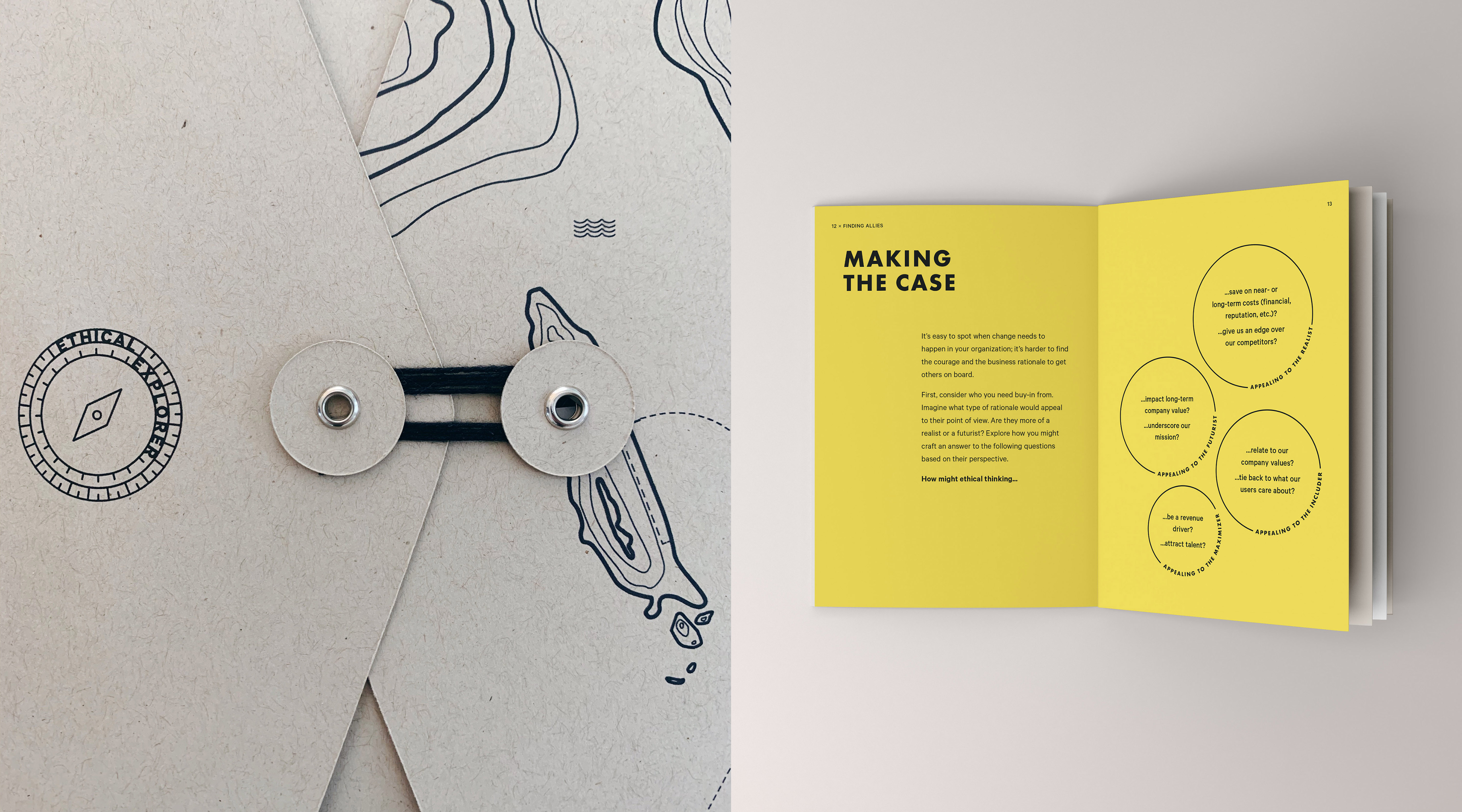
We know tech products have real consequences in the world. Designers and builders like you are increasingly at the forefront of a shift toward more responsible technology. Yet generating awareness and conversation around tech ethics in an organization can feel like an uphill battle, full-time job, and unchartered territory all rolled into one. That’s why Omidyar Network and Artefact partnered to create the Ethical Explorer Pack, a toolkit to help individuals and teams build technology that’s safer, healthier, fairer, and more inclusive for all.

In this webinar, Sarah Drinkwater, Director of Beneficial Technology at Omidyar Network, and Hannah Hoffman, Design Director at Artefact, share the thinking behind the Ethical Explorer Pack and how you can use the toolkit in a variety of situations during the product development life cycle. Download the free toolkit and learn how to advocate for more responsible tech in your organization, no matter your role.

Check out the resources shared by attendees below, and be sure to sign up for our Impact by Design event series to keep the conversation going.

Artefact stands in solidarity with the Black community as an ally in the fight against inequality and injustice. The fundamental mission of Artefact is to create a more equitable and sustainable world. Combating individual and systemic racism is everyone’s responsibility, and we take this mission seriously.

We have spent the past weeks listening, learning, and continuing to examine how we can do better as an organization and community. Inclusion is a foundational value of Artefact, but we must and will do more. We are strengthening anti-racism practices within our organization, as well as continuing to advocate for equity, inclusion, and justice in our craft through responsible design.

I want to reiterate that we are listening. Please share with us any feedback on how we can engage with our community and industry to be more equitable and inclusive.

Thank you,

Rob Girling, CEO


We encourage you to join us in learning from the voices of designers, creatives, and strategists who have been committed to growing and sustaining this movement:

Justice by Design

Antionette Carroll, Founder and Executive Director of Creative Reaction Lab, explores in this talk how creatives have the ability and responsibility to use design in crafting a more just world.

Originality and Invention

In this panel, photographer Carrie Mae Weems, architect Sir David Adjaye, and Professor Sarah Lewis discuss how the creation of space and institutions can challenge societal understanding of justice and identity.

The Value and Importance of Conflict

Visual designer Rick Griffith examines in this talk how constructive conflict of ideas can contribute to meaningful change in communities and society.

How to Think Differently about Doing Good as a Creative Person

A guide to social impact problem solving rooted in equity, consent, and co-creation, by engineer Omayeli Arenyeka.

Revision Path

A podcast by creative strategist Maurice Cherry showcasing the experiences and inspirations of Black creatives across the design continuum.

Redesigners in Action Webinar Series

An introduction to Equity-Centered Community Design, a process and framework by the Creative Reaction Lab that aims to deliver more equitable and just outcomes through design.

Where are the Black Designers?

A virtual conference on June 27 to connect and elevate creatives of color and spark conversation around representation in the design community. The event is open to all professionals.

“You can design and create and build the most wonderful place in the world. But it takes people to make the dream a reality.” – Walt Disney

After almost 14 years at Artefact, I will be stepping down as co-CEO on June 11, 2020. Rob Girling will serve as sole CEO, and I will remain a partner in the company and an advisor to leadership. As always, we remain fully committed to our customers, continually striving to make a positive impact in the world through our work together.

It has been an honor and a privilege to work with the Artefact team over the years. You have helped build something truly special and made my dream of a purpose-driven design studio a reality – thank you. And to the companies who chose – and continue to choose – to work with us, I am sincerely grateful for your trust and allowing us to work alongside you to bring your ideas to life. 

I want to thank Rob for being such an inspiring business partner and friend – I could not imagine a better collaborator. Rob and the Artefact team will continue to deliver the world-class design that has made Artefact one of the best in our field, and I am excited to see him lead Artefact to new heights.

Lastly, I’d like to thank my wife Jenny for being so supportive when I first decided to ditch the corporate life and start my own business. This move has been in the works for some years, and as for what comes next, I do plan to relax for a while, explore some new interests, and spend time with my family and reconnecting with friends.

Thank you, Artefact for a remarkable journey!

Sincerely,

Gavin Kelly