Editor’s note: In partnership with Design for America, Artefact co-CEO Rob Girling moderated a panel discussion February 2019 at Airbnb’s San Francisco headquarters on trust and social impact. The event featured Alex Schleifer, VP of Design for Airbnb, and Valerie Casey, Head of Design at Walmart. Here, Rob builds on his opening remarks to highlight Artefact’s point of view on product trustworthiness as a component of responsible design.
At Artefact, we focus on designing digital products and services that are trustworthy. Trust is a complicated design challenge, but it can be meaningfully achieved through the practical application of ethics – here’s why it matters:
Machine learning algorithms hold vast
potential, but with their great power comes significant responsibility. Over
the last year, as perspectives around such algorithms continue to mature, almost
all technology companies have endeavored to establish (with mixed effect)
ethical principles, boards, and codes of conduct. Their goal? Get ahead of the
implicit but very concerning risks associated with the algorithms going wrong for business, people, and society.
As a result, a once highly philosophical and
impractical debate on ethics in innovation circles is increasingly relevant to
tech – with deep implications for product design. Correspondingly, “responsibility”
has begun to replace “desirability” as design’s primary value add, and a new focus
on ethics has supplanted our discipline’s longtime focus on beauty and delight.
This overall shift from a governance perspective on ethics to the practical awareness
of ethics in the product development process represents a significant moment
for the tech sector.
The business as well as moral
imperatives could not be clearer.
In Artefact’s recent report, Can Social Media Be Saved?, we show that social media technology platforms do not inherently generate positive outcomes. Unchecked, they are also highly susceptible to manipulation and exploitation, which, as we’ve seen with Facebook, can degrade trust and profitability.
Strong ethical principles, policies,
and practices are essential to any company that wants to build and maintain
trust with its stakeholders – from employees, customers, and partners to
governments and shareholders. At the center is a code of ethics that helps make
real the organization’s mission and brand promise. When actions (or inaction)
appear in conflict with the organization’s ethical code, the trust relationship
is undermined and the estimation of the organization in the eyes of its
stakeholders can be dramatically reduced, driving loss of share value, customer
churn, slower market adoption, low employee morale, and even employee
attrition.
As two of the world’s largest
companies, Apple and Microsoft, increasingly view their brands and products through
an ethical lens, consumer expectations around ethics are on the rise, helping
to set new norms that are pushing aspiring organizations to follow suit. Additionally,
competitive advantages exist for companies that choose to apply a strong
ethical perspective into their product designs.
At Artefact, we help our customers envision and develop trustworthy technology products using a methodology that we call Responsible Design, which prioritizes long-term outcomes, the alignment of corporate mission with practical ethics, and deeply understanding and resolving competing stakeholder interests as much as great design execution. Throughout, we approach design challenges with a systems lens, asking hard questions about unintended consequences as well as net impact to ensure that the design solutions we deliver to market are positive for business, people, and society.
There are of course
nuances to every client engagement, but Artefact’s commitment to product
trustworthiness is unwavering. We believe designing for trust is a critical, increasingly
competitive asset in today’s rapidly evolving marketplace and strongly encourage
organizations to integrate ethics into their core product offerings. Responsibly
aligning the potential of technology with its future impact is also fundamental
to creating a better tomorrow for all of us.
Using blockchain to reverse climate change: A conversation with Nori
From smart contracts in the homebuying process to swiftly and securely transferring money overseas, blockchain solutions are becoming increasingly common in sectors such as finance, real estate and the Internet of Things. Distributed web solutions like blockchain provide crucial security and accountability functions that transform our relationship with data. In other words, blockchain delivers trust and transparency – two things we at Artefact take very seriously when it comes to technology and its impact.
At Artefact, we’ve been exploring what role blockchain can play in wrestling with the many intractable, systemic problems facing our world. Moreover, as designers and technologists, how can we harness blockchain solutions in ways that contribute to accessible, equitable and sustainable outcomes?
One of our favorite companies working at the intersection of blockchain and social impact is Nori, a Seattle start-up creating a blockchain-based marketplace for removing carbon dioxide from the atmosphere. We sat down with Nori’s Founder and CEO Paul Gambill to talk distributed tech, social impact and seaweed.
What does Nori do and how did you get the idea for it?
Nori is on a mission to reverse climate change. We are building a marketplace that makes it easier for people to pay to remove carbon dioxide from the atmosphere. Climate change is a really straightforward arithmetic problem: there is simply too much greenhouse gas in the atmosphere. What we need to do is draw it out – undo the emissions – to restore the balance of the carbon cycle and ultimately reverse the effects of climate change. Most people working in the environmental space are trying to make climate change less bad, but nobody is trying to actually reverse climate change – until now.
Why do you think carbon removal isn’t more widely discussed as a solution for combating climate change?
People make a moral hazard argument against carbon removal. Many environmentalists don’t want a focus on carbon removal because they think that creating technologies and processes to remove carbon would give humanity a license to continue emitting carbon dioxide. What these environmentalists want to see is everyone reducing emissions.
The fact of the matter is, climate change is simply too far gone. Even if we halted all emissions tomorrow, the environment will not naturally recover to a place of balance without serious harmful impact. According to the math, we have to draw carbon dioxide down. There’s no other choice.
How does Nori use blockchain to help reverse climate change?
In the Nori marketplace, buyers pay to remove carbon dioxide from the atmosphere and suppliers remove the carbon dioxide. When a supplier in our marketplace removes carbon dioxide from the atmosphere, we have an independent, third-party verifier come in and assure that that carbon has been removed according to peer-reviewed standards. Nori then issues that supplier a Carbon Removal Certificate (CRC) that exists on the blockchain. The CRC can be sold to a buyer in exchange for one NORI token. One token always purchases one tonne of carbon dioxide.
We do this on the blockchain because proving who has removed carbon dioxide, who has paid for it, and who should get credit has been a longstanding problem in legacy carbon markets. We are eliminating those risks by putting the process on the blockchain, making it incredibly straightforward to prove who owns what and at what time.
The other half of your business is the NORI token. Why is a token necessary for your carbon removal marketplace?
Creating the NORI token as a separate asset from the CRC gives us the ability to create a global, market-driven reference price for carbon dioxide. One NORI token will always be used to buy one tonne of carbon dioxide. The price of the Nori token in the exchange markets – relative to the dollar or to bitcoin or any other currency – can be seen as a global reference price, sort of like Brent Crude or West Texas Intermediate pricing for oil.
A global carbon price is also useful for people who aren’t participating in our marketplace, like policymakers, economists, auditors and anyone else who needs to know how to value carbon. These groups have wanted a price for carbon for decades, and Nori does that by creating the cryptocurrency asset.
Why hasn’t carbon pricing worked in the past?
There are lots of problems with the legacy carbon markets. One major point is that when people talk about putting a price on carbon, what they’re often trying to do is create a cost for emitting carbon, like a carbon tax or the cap-and-trade market in the European Union. They’re putting a price on what it costs to emit. We think that’s a very negative action.
Nori wants to turn carbon dioxide from a waste product into a new value stream. The carbon price Nori is talking about creating is the value of removing one ton of carbon dioxide. Think about carbon dioxide like garbage, where for decades we’ve been throwing our garbage out in the street and nobody has been doing anything about it except try to throw less garbage out. The trash is still piling up out there. Nori makes it possible for the garbage collectors to get paid for coming around and picking up the trash.
We’ve discussed on our Reversing Climate Change podcast why carbon pricing has consistently failed in the past if you want to dig into the nuance.
What are some common concerns companies have with a blockchain-based carbon removal marketplace and what’s your response?
The cryptocurrency aspect of the Nori marketplace makes some people wary. They’re concerned about the volatility of the currency and what we at Nori are doing to ensure that the Nori token doesn’t fluctuate wildly which makes it difficult and unpredictable to use. There’s a lot more detail in our white paper, but the short version is that we are slowly releasing NORI tokens over time, so that we should as closely as possible tie the value of NORI to the value of removing one tonne of carbon dioxide.
They are also concerned about security. If you lose your bank account password you can get that reset, but if you lose your password to your cryptocurrency wallet, that money’s gone. Those concerns are valid and real, but there are plenty of tools and solutions out there that make this workable. Blockchain is just something new that companies must get used to. When talking about large sums of money, people are hesitant to commit to something that’s entirely novel. It’s similar to when credit cards were first used to make payments for websites. People were uncomfortable, but then tools were developed to make it safer. The same will happen and is happening with cryptocurrency.
Speaking of novel solutions, how do you design for and around blockchain infrastructure that your customers may not yet relate to or have as much trust in?
It’s true that existing blockchain applications are not user friendly at all. My background is in computer engineering, I worked in software development my entire career, I’ve been using bitcoin and blockchain technology since 2010, and even I find these applications incredibly difficult and confusing to use. There’s a lot of low-hanging fruit in terms of what designers can do to improve the ways people can interact with the blockchain.
Ultimately, the future I want to live in is where blockchain is something that simply runs in the background, just like how most people don’t know how HTTP works to load pages in your web browser or how SMTP works to send e-mails. These are protocols that don’t matter to the user experience. At the end of the day, just don’t make users think about it. They shouldn’t have to learn how blockchain or cryptocurrency works at a fundamental level. Only show them what they need to know in order to make responsible decisions about how they need to interact with the application.
What business opportunities do distributed web solutions like blockchain present?
Blockchain isn’t a cure-all solution for everything and there are many cases where a centralized database is still a better solution than blockchain. There are many fantastic use cases for blockchain, however. For example: issues of provenance (proving who owns what at what time, like with Nori’s CRCs); creating markets; and creating incentive structures to encourage people to make some kind of behavioral decision using a token.
The use of blockchain is often not going to be anything the consumer sees on the front end, but will instead power behind-the-scenes solutions, such as in the supply chain. Walmart, for example, tracks the movement of their produce from seed to sale using the blockchain so that if there is some sort of bacterial outbreak they can trace it to exactly where it came from and who’s responsible. T-Mobile uses blockchain for handling the audit trail for an internal identity platform.
Companies with operations that can use better tracking or could benefit from incentive structures can find the most opportunity in distributed web solutions. I can guarantee you that many large Fortune 500 companies are experimenting with blockchain solutions right now.
Last but not least, what does “Nori” mean, anyway?
There are lots of different ways to sequester carbon dioxide, and one really cool ecological approach is to grow kelp or seaweed. It’s very easy to do using just rope, water, and photosynthesis. “Nori” is Japanese for seaweed!
April 18, 2017 wasn’t just any other Tax Day. Around this time one year ago, Artefact was knee-deep in numbers working on a unique feat of data visualization: USAFacts – the first comprehensive database of US government statistics illustrating where tax dollars go and why. In the year since USAFacts launched, close to one million people have visited the site, demonstrating a clear desire to better understand government data. Seeing the impact of the platform got me thinking about why USAFacts resonates with so many, when government data already existed in the public domain. The key? Making the data approachable, and placing it into context that ensures accuracy while encouraging exploration and understanding.
When creating data visualizations, it’s our responsibility as designers not just to make beautiful graphics, but to give users the tools to grasp the wider context of the information before them. Yet context can be a challenge, adding in complexity when we seek simplicity in our visualizations. After a year of working on USAFacts, I’ve learned three design approaches to help place data in context and create beautiful, accurate visuals that empower users to understand the complete picture.
1. Show data as parts of a whole
Statistics lack meaning in isolation. If you show select numbers divorced from their larger context, at best people walk away with numbers without substance. At worst, you’ve introduced bias or implied causation where there is none. The solution: when showing parts of data, always ensure there is a view of the whole.
One of my favorite visualizations for USAFacts illustrates the impact of the federal budget. It can be difficult to grasp the practical implications of a budget that tosses around numbers in the trillions. To introduce context for the user, we added benchmarks for comparison by juxtaposing the plan against actual historic budget data and independent projections from the Congressional Budget Office. Then, we introduced controls for inflation and per-capita adjustment that allow users to understand the significance of the numbers in comparable terms.
Historic context is vital to painting a holistic data picture. Consider annual US foreign aid spending. On the one hand, $46.7 billion is a lot of money, but on the other hand, the figure is less than 1 percent of total federal expenditure. Moreover, annual foreign aid in aggregate increased for about a decade since 2000 but has been in decline again since 2012. Trends and cycles show the historic significance of a particular data set. Whether or not the numbers necessitate policy reform is for the user to interpret, but it is our role as designers to demonstrate how discrete data is part of a larger whole.
2. Layer in factors of understanding
Designers often pare down data visualizations in the name of beauty, but oversimplifying information can strip away the very context that gives data meaning. One way to retain that valuable context in a digestible manner is to add information in layers. This allows users to navigate through related data that can help them gain a more holistic perspective.
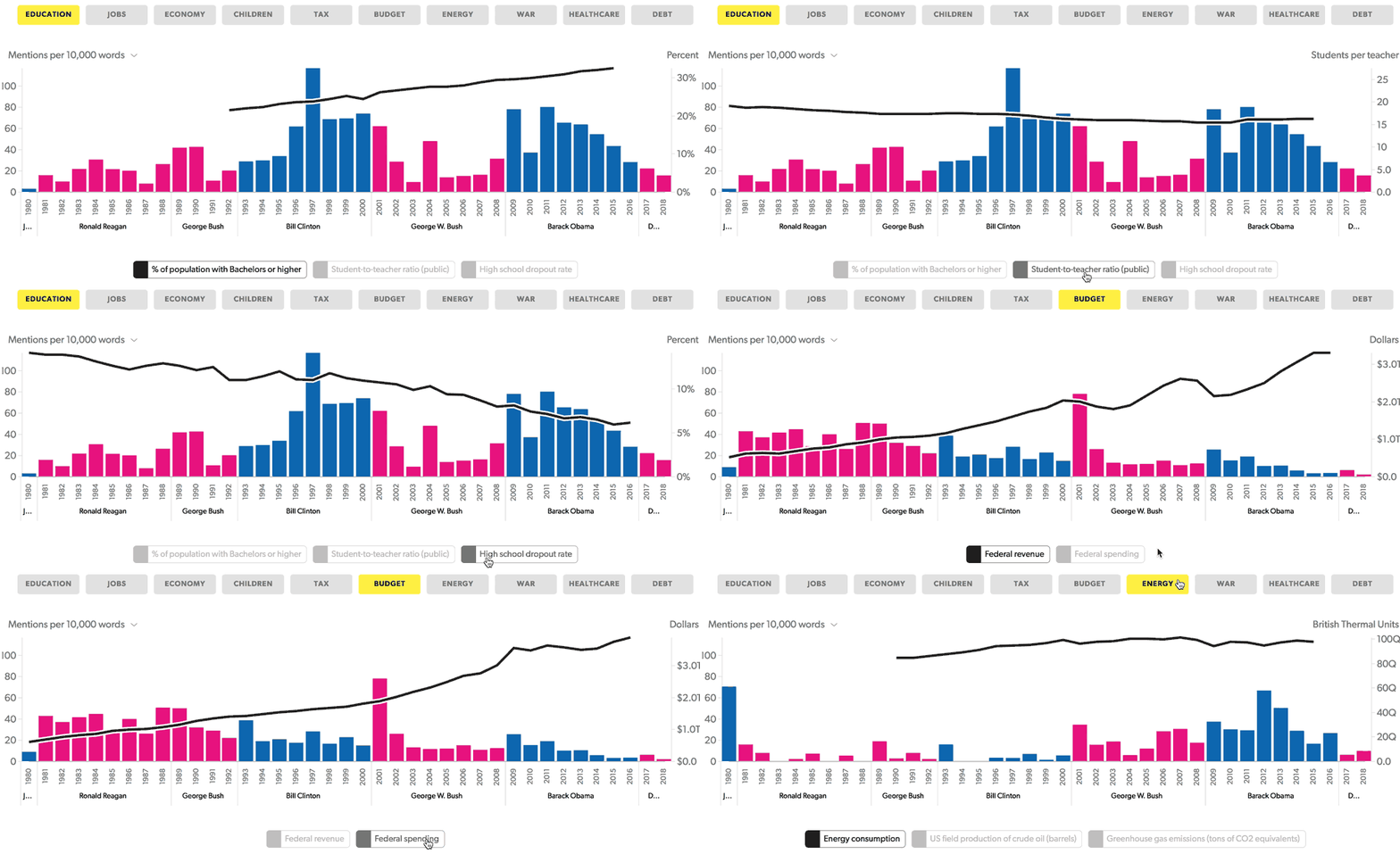
USAFacts’ State of the Union visualization maps out how often a president mentioned certain topics in each State of the Union address, overlaid by related metrics for that year. For example, you can see how often a president used the words “budget” and “spending” in relation to total federal revenue and expenditure in the corresponding year. The issues are broken out into several categories such as education, jobs and healthcare, allowing users to toggle back and forth between topics. The visualization provides an intuitive understanding of which issues were paid lip service and which were prioritized.
3. Create pathways to comprehension
Visualizations that thrill data enthusiasts can overwhelm others. One way to improve clarity is by creating pathways of discovery that let users choose their own adventure. This provides context while making the data digestible to a wide audience.
We designed USAFacts to encourage exploration, with a “simple first, detail upon interaction” process that progressively discloses information. In illustrating the impact of the Tax Cuts and Jobs Act of 2017, for example, we created an automated timeline that runs through projected changes in revenue and spending based on current policy compared to the new reforms. Casual users can start from a bird’s-eye view and let the visualization walk them through the data. Those seeking specific information have the ability to jump into the visualization and explore on their own.
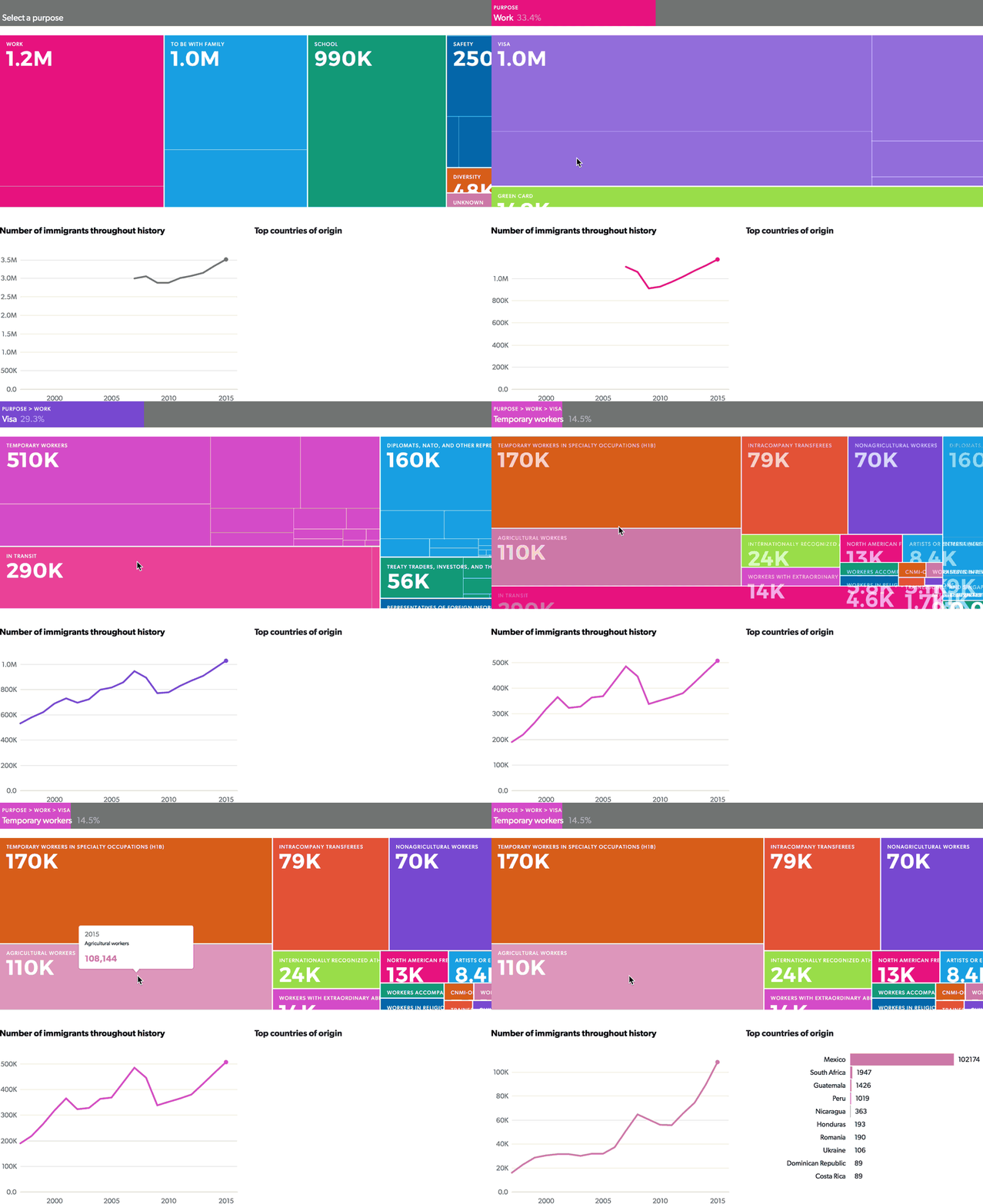
We took a similar approach with the visualization for immigration statistics, starting with the broader question of, “Why do people come to the US?” Purposes for immigrating – such as tourism, work or safety – are color-blocked in one simple treemap chart. Users can then dive into their category of interest. For example, selecting “work” zooms into the types of work visas issued, with further detail on which countries of origin are most represented. In this way, users can quickly understand what broad forces drive immigration, while also having the capability to drill down to such granular figures as the percentage growth of agricultural workers immigrating from South Africa since 2011.
Cumbersome government reports discourage engagement. USAFacts makes the data approachable, dynamic and – dare I say it – even fun.
Lies, damn lies, and statistics
“There are three kinds of lies,” Mark Twain famously observed, “Lies, damned lies, and statistics.” Today more than ever, the sheer volume of data propelling our world makes extracting meaning from statistics difficult at best. Those of us entrusted with framing data have the opportunity to encourage data literacy. Designing context into data visualizations give numbers significance and help differentiate the “damned lies” of data from the valuable insights we all seek.
You’ve probably seen someone with a VR headset jump or lose their balance in reaction to their virtual surroundings. Although it may seem strange to the observer, VR is a highly persuasive medium capable of having a deep impact on the brain. Just how persuasive? VR experiences have the capacity to alter our emotions and behavior well after we unplug.
VR is still an evolving medium, but we know enough about its influence to give us pause. There is an ethical responsibility to explore the impact of VR experiences on users and empower them with awareness and control. Let’s look at how VR influences emotions, perceptions of self and behavior – and what we can do to support users along the way.
Emotions transcend the virtual
Social interactions in VR aren’t constrained to the hardware. Not only are the thoughts and emotions that bubble up during VR experiences genuine, we bring them back into the physical world with us long after the headset is gone. They affect us just as much as an in-person interaction, giving the emotions we feel in VR the healing power of a trusted friendship or the psychological stress of a bully.
The 360-degree short film Clouds Over Sidra is a compelling example. The video captures the perspective of a 12-year-old Syrian girl living in a refugee camp with thousands of others. As a viewer, you become fully immersed in her world – making eye contact with others in the camp, who in turn react to your presence. The experience often triggers emotions as if you were physically there. In fact, the same mirror neurons fire when we perform an action ourselves as when we observe someone else perform the same action. This makes VR experiences a powerful way to build empathy.
Of course, social interactions are far too often negative. I hadn’t considered the significance of bullying or abuse in VR until reading about one woman’s experience in a multiplayer game. Despite having the same non-gendered avatar body as other players, the author’s partner in the game mission recognized her female voice and proceeded to grab and pinch where her chest would be, virtually groping her. Although it didn’t look or physically feel like assault, remember the mirror neurons. Our brains can’t tell the difference. VR bullying and abuse have real, emotional repercussions.
How do we give users the opportunity to experience the emotional benefits of VR while protecting them from abuse? A good first step is to give victims the tools to protect themselves, such as the ability to evade and block other users. Platforms could require persistent bullies to undergo empathy training in VR, as well. Massachusetts preparatory school the Concord Academy created a VR project specifically to combat bullying. Users experience a bullying incident from multiple points of view: as a bystander, victim and perpetrator. In this way, VR can help people understand one another on a deeper level and decrease abusive behavior in the virtual and real world.
Avatars impact perceptions of self
Ever wondered what it would feel like to live in someone else’s body? Taking on a virtual avatar may be the closest comparison. Research shows that inhabiting a virtual avatar alters your sense of self as well as your capabilities in the real world.
When our brains receive sensory, visual and perceptive feedback that align, it can be fooled into feeling ownership over another body. Several studies have demonstrated this body transfer illusion, notably the rubber hand experiment. In this investigation, participants hid one hand out of sight and a realistic, synthetic hand was put in front of them. Both real and artificial hands were stroked simultaneously. When later told to point to their other hand, participants reflexively pointed to the rubber hand rather than their actual, physical hand. The effects of body transfer illusion are even more powerful in VR. Another study gave participants VR avatars and then introduced physical threats in the VR environment. Not only did participants’ heart rates change in reaction to the perceived threat, they later reported feeling significant ownership over their avatar body.
Creating an illusion of body transfer can have great benefits, especially in training for dangerous or high-stakes situations. Virtual experiences trigger genuine emotional and physical reactions in users, making it a great tool for learning, confidence-building and communication. For example, a surgeon can practice open-heart surgery in VR and later use that retained muscle memory and visual feedback to perform the operation on a patient with confidence.
Creators of VR need to be aware of how much a user should embrace their virtual avatar. For example, individuals with avatars entering a high-stress situation should mentally prepare for the task ahead in the same way they would if performing it in the physical world. Depending on the application, it may be necessary to integrate environmental elements that remind the user of the virtual nature of their world. To prevent desensitizing a user playing violent video games, for example, VR could introduce a transition where the user “puts on” the avatar body, or crosses over a bridge or gateway into the virtual world. This helps compartmentalize where violence is acceptable and where it is not. In a VR application that is meant to be therapeutic or empathy building, a grounding element may detract from the experience. In this scenario, the user benefits from the long-term impact of fully embracing their VR avatar and experience as their own.
Immersive experiences influence behavior
Imagine waking up to a flashy new sports car in your driveway. You get inside the vehicle for a virtual test drive, and your avatar is wearing swanky driving gloves. You’re really starting to feel like a luxury car owner now – the only thing left to do is sign your name on the purchase contract. Do you do it? Your decision might surprise you.
Studies show that VR experiences influence behavior and decision-making. Consider one study that gave participants avatars resembling aged versions of themselves. When interacting as their older avatars, participants were more likely to sacrifice immediate financial rewards for long-term benefits. Researchers concluded this experience opened up cognitive channels that increased real-world interest in saving for retirement. Another study gave participants VR avatars of differing heights and asked them to participate in negotiation exercises. Those with taller avatars behaved more confidently and negotiated more aggressively.
The heightened ability to persuade and influence decisions in VR makes it a powerful way to deliver advertising. Although there can be benefits – such as a higher fidelity means to test and better understand products – it can be difficult to identify where the environment ends, and advertising begins. The immersive nature of VR could lead users to lose control and make decisions that they wouldn’t in the real world.
Users should be able to recognize behavioral influencers like advertisements and have the opportunity to opt in or out. An ad callout and different visual treatments can help users distinguish promotions from other content. Furthermore, advertisements should take up no more than 20 percent of a user’s field of view to protect the user experience. Companies are starting to adopt policies and limits to VR advertising. For example, Unity – a VR development company – has an immersive advertising product called Virtual Room that requires users to opt in to see branded content. Their VR advertisements display for no more than two minutes each hour.
Power and peril
VR is still a “wild west” of sorts. Immersive virtual experiences, the role they play in our lives and the policies that govern them are evolving. It’s clear, however, that VR experiences have a tangible emotional, cognitive and behavioral impact on users. And the impact carries over into the real world.
For creators, this means the stakes are higher in VR than other digital mediums. We have the opportunity to help users harness the power of VR experiences while protecting them from harm. I believe that starts by creating VR experiences with a thoughtful, research-driven approach and ensuring users have awareness and control throughout their virtual experience. As designers, developers and even advertisers, it’s important to approach the VR medium with caution and remember to consider the full impact of VR experiences: who benefits, as well as who “pays.”
Artefact joins Seattle mayor’s new Innovation Advisory Council
Artefact is honored to serve Mayor Durkan and the people of Seattle as a co-chair of the first-ever Innovation Advisory Council (IAC), a new collaboration between the tech sector and local government that aims to harness the power of technology to help solve the city’s most pressing problems. From homelessness to transportation and mobility, the IAC will advise on issues affecting the city as well as assess and propose where data and technology solutions could be of benefit.
“Seattle has always invented the future, and companies like Artefact are essential to the Innovation Advisory Council and its development of technology solutions that will help our city address our most pressing challenges. By utilizing Artefact’s responsible design approach, we will create a better future together,” said Mayor Durkan, who launched the IAC through Executive Order at a press conference in downtown Seattle.
To the role of co-chair, Artefact—the only design firm on the IAC—will contribute our world-class product and systems design thinking to help Mayor Durkan and the City of Seattle reimagine opportunities at the intersection of technology, product innovation, shared value, and social impact.
Our fellow co-chairs include Expedia, Tableau Software, and Technology Access Foundation. Other members of the council include Amazon, Flying Fish, Microsoft, Washington Technology Industry Association, and Zillow Group.
A big thank you to Mayor Durkan for including Artefact in your vision for shaping a better tomorrow. The issues are as urgent as they are complex, but we are eager to shape newfound strategies and solutions that help make a difference for all who call Seattle home.
In the 1830s, tabloid publisher Benjamin Day lowered the price of his paper to a single penny. It was a dramatic five cent drop for the customer, paid for by advertisements that appeared on the pages of the New York Sun for the first time. This new model meant that the readers of the Sun were no longer the customers, but in fact the product itself. If this sounds familiar, it’s because we are wrestling with the weight of this tradeoff today in the context of social media. What does it mean when the platforms we use to keep up with college friends and cat videos use us back? And how is it that barely anyone truly understands how their data and their web presence is being used?
News that Cambridge Analytica exploited the data of 50 million Facebook users without their awareness is the latest and most shocking example of our data used in damaging ways. But it is by no means singular. There has been a steady drumbeat of stories that reveal the hidden cost of “free” platforms. Uber tracks the data in such detail that it knows people will pay surge pricing if their phone battery is running low. Fitness app Strava inadvertently revealed sensitive military locations by making a marketing campaign from running maps. Just as I was writing this, Under Armour revealed a data breach affected 150 million users of the MyFitnessPal app. Taken together, all have a common lack of transparency around 1) what these organizations know about each and every one of their users, and 2) how much of this knowledge these organizations actually share with their users. In this opaque and secretive system, users are left vulnerable and disempowered to protect their own data.
I’m not arguing against social media platforms, and it’s safe to say they are here to stay. After all, the model has existed since tabloids cost a penny. So where do we go from here? This is my challenge to all designers: It’s time to start designing for transparency rather than delight. Trust is the most important thing that any organization can earn from individuals, and the best way to earn that trust is by being transparent. Let’s use our role as user advocates to help organizations take responsibility by rethinking the ways in which they communicate who, what, where and how data is being used.
To begin, I propose the following five principles for designing for transparency.
1. Explain what data you collect, why you collect it, and how it makes you money.
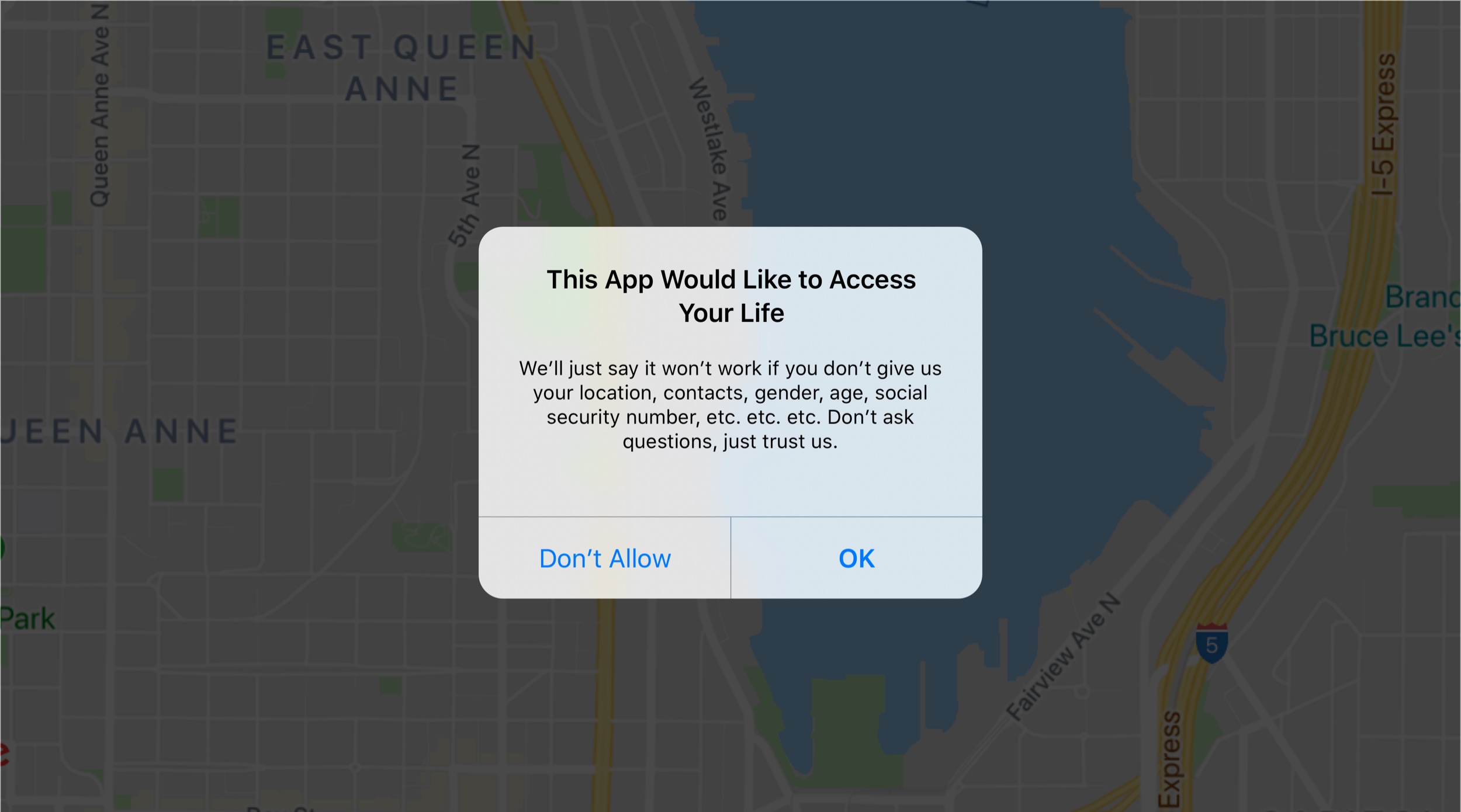
Online clothing retailer Everlane is a company who has managed to represent — in a simple way — to its customers how it makes money from its products through a transparent pricing structure. We can draw inspiration from this to push beyond the simple understanding of “Your data is used to advertise.” Tech companies collect and scrape enormous amounts of data: location, search results, purchase history, and even text and SMS. We need to be ready to ask ourselves: do we actually need access to a user’s location information? For example, ridesharing services work just fine without your location data, but they present language to customers to make it seem like location services is a requirement in order for the app to work. Data disclosures should be as detailed as the data itself, and we need to stop hiding this information through opaque practices or omission. Make it clear to your user in specific terms. If you can’t explain it or don’t want to, then you probably shouldn’t be doing it.
2. Allow your design to explain your algorithms.
The podcast ‘Reply All’ recently ran an episode entitled ‘Is Facebook Spying On You?’ in which people presented anecdotal evidence about talking about random products and then immediately seeing it as an ad in their Facebook newsfeed, causing them to wonder if the microphone in their phone was being used to listen in on their buying decisions. In short, the Reply All hosts concluded that coincidences in newsfeed ads had more to do with the ways Facebook tracks your movement all over the web through an analytics tool called Facebook Pixel. But the suspicion lingers because there is a lack of understanding for what you see in your feed and why. To address this and build trust, we should design space for people to understand “Why am I seeing this ad?” Advertisers, after all, are able to target everyone from ‘new parents’ to people who like both KitKats and Nike shoes. This goes beyond advertisements as well. For any kind of feed, people should have transparency as to why the algorithm surfaces what they are seeing and why. Give options that will reveal these demographics to your end users, and allow them to weigh in and set options on what the algorithm provides them. Some companies are starting to respond to customers’ algorithm frustration. Pinterest just released a feature in which you can view only posts from people you follow (no “recommendations”!) and in chronological order as well. Hopefully more companies follow suit in empowering their customers to take control of their feed.
3. Allow your customers to opt into data collection, rather than opting out of it.
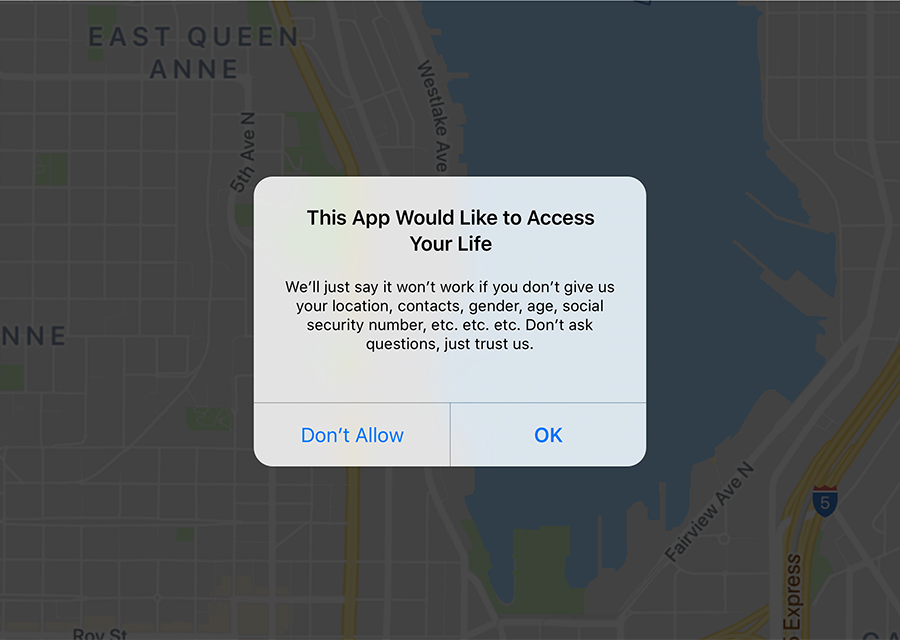
There’s nothing more powerful than the default. Have you ever downloaded a new app, and have seen the notification of all the things it wants access to—like all your contacts? Did it give you pause, but you went ahead and tapped “Allow” anyway?
Uber abused this in the most egregious way, when, in 2016, its default setting was quietly changed to tracking its users all the time, rather than just when they were using the app. Users were outraged by the change, and Uber had to walk it back less than a year later. Designers need to insist on transparency about users’ privacy settings, and solutions that allow users to opt in, rather than opting out of data collection. This forces our organizations to justify the need for data rather than just collecting it because they can. Zeynep Tufekci, a professor of Information Science at University of North Carolina, notes: “As long as the default is tracking, and as long as the burden is on the user, we’re not going to get anywhere.”
4. Examine and consider how bad actors could use your system. Then prevent it, prepare for it, and be ready to react in real time if it happens.
Designers often seek to change, update or tweak features with the best of intentions and inadvertently expose users to risk, exploitation or abuse because not enough time and resources have been invested in understanding the possible impact of change. In 2017, Twitter quietly removed notifications to users that they’ve been added to lists. After worried users raised issues — I want to know, as a woman, if I’m added to a misogynist troll’s hate-filled list of women they hate — Twitter’s safety team backtracked after only two hours. It’s a reminder that designers need to consider how the worst person you can think of might use not just your platform, but your features, and that includes your privacy settings, notifications (or lack-thereof), and, in a last example, rolled-up location tracking. This is why creating transparency not just about what you’re collecting, but how you will eventually use that data is so important.
5. Media literacy matters. It’s time we prioritized data literacy.
Media literacy matters because it enables people to discern reputable information, seek out sources and make wise decisions about the content they consume. We should apply that same logic and advocate for data literacy, an active form of transparency that educates people on the full truth of data collection so that they can be empowered to make proactive decisions about the information they share. If we implemented the principles outlined above, the result would be a drastic increase in communicating what data is being collected and why, as well as increased control of what people can opt into and how they can manage the algorithms that shape their experiences. Designing for data literacy would represent a significant shift in how data is conveyed today, moving us away from an opaque understanding of the most basic “free platform in exchange for data” transaction that has left so many users feeling distrustful, confused and surprised by the actions of social media platforms.
Sunlight is the best disinfectant
After trusting enormous amounts of their personal information, it’s easy to understand why social media users are starting to question if the deal was worth it when so many services have managed to abuse and break that trust in exchange for revenue. Unless there are changes to the way we communicate data collection, algorithm decisions and advertising models, trust will continue to erode. And that’s where designers can use their skills to help take responsibility for how we are collecting and using people’s data and help restore trust. If what you are doing gives you pause as a customer, you should respond to that feeling. We need to reaffirm our position as user advocates, which has always been the key to being a good designer in technology, to design for transparency and data literacy just as often we design for joy, delight, and engagement.
In the anti-corruption world, there’s a saying that sunlight is the best disinfectant. Let’s let go of the opaque practices that harm our users and add sunlight to our design work.
We recently got the chance to sit down and roll up our sleeves with Splash, an organization dedicated to bringing sustainable sanitation, hygiene education, and clean, safe water to children around the world. Together, we explored ways we could make their drinking and handwashing stations more durable, engaging and usable in settings where the challenges are numerous, from orphanages in China to resource-strapped schools in Ethiopia.
As designers, we relish projects like this because they are rooted in impact and purpose. It’s not about creating the shiniest, sleekest product possible. It’s about understanding the lives of the children who will use these handwashing stations, seeing the world in which they live, and designing solutions that are built to be used and built to last. Designing for social impact requires us to turn challenges and constraints into insights and inspiration, and we’ve found that by drawing on context, harnessing the power of human behavior, and staying humble and curious, we can always find new ways to deliver results for the people who need them most. Splash lives this ethos in the work that they do, and use this mentality to create real impact in the communities they serve around the globe.
https://www.instagram.com/p/BXtLhNYFdLV
Don’t fight the system
A clean water station seems like a simple thing. But there is always a bigger picture at play, and we must consider unique systems, customs, and environmental factors beyond usage. By understanding the larger system in which it works, Splash is an excellent example of an organization that successfully scales its solutions far beyond the individual stations to include things like parent and teacher trainings, school funding, soap drives, and celebrations of global handwashing days. This hybrid of a human-centered design strategy and a systems-level approach moves beyond tackling one problem at one pain point and empowers designers to design for social change.
Keep it simple
Employing simple behavioral economic strategies can be one of the most effective tools in a designer’s arsenal, especially when resources are limited. Splash learned that many of the students they worked with were not accustomed to having regular access to faucets or soap and that employing simple behavioral nudges like positioning mirrors over the basins at child-height increased handwashing rates from 9.4% to 65%. We worked with Splash to develop similar concepts like creating areas on the basins that students could customize with artwork and rotating the sinks 45 degrees so that users faced each other while using the taps because when children can see each other as they wash their hands, they are more likely to use the stations.
Photo credit: Splash
Stay humble and curious
As part of our partnership with Splash, we facilitated a Behavioral Change Summit where members from word-class design firms, non-profits, public health companies, and research institutions were invited to think up ways of improving the drinking and handwashing stations. Situations like these require the acknowledgement that everybody is an expert and nobody is an expert. Remember to listen and consider what you hear, be humble, build off of each other’s unique life experiences and strive to make the people who will use the product the priority in all things. While it may be tempting, you simply can’t parachute into a design problem and employ methods that worked in other situations. In fact, creating a successful innovation sometimes means dropping the pretense of being super innovative all together and starting back at square one.
Photo credit: Splash
At Artefact, we are always grateful to get the chance to think meaningfully with organizations like Splash. It inspires us to dig deeper into the world around us, reflect on how humans can be empowered within larger systems at play, and seek out the right mix of innovation and practicality. Keep an eye on Splash and the amazing work they do—we will keep watching and drawing inspiration from the way they bring their purpose and vision to life for children all around the world.
Twice a year, Artefact employees take 24 hours to team up for the Artefact Hackathon to see what they can create using everything from open source software to pipe cleaners. At the end of the 24 hours, we are always left with a giant mess, leftover pizza, mild sleep deprivation, and many, many awesome ideas.
Our latest Artehack was no different. Each team rose to a unique challenge, resulting in everything from a Roomba built for disaster relief to an AI-enabled confessional for the future. However, two Artehack projects tackled a subject particularly close to us as a company: alleviating homelessness. As part of the Seattle community, Artefact is invested in finding ways to improve the homelessness crisis, such as our partnership with the Seattle Mayor’s Innovation Team to create solutions for homeless youth. These two hackathon projects are just prototypes, but demonstrate that people can use design thinking to solve tangible problems as part of tackling the larger challenge of homelessness.
How might we cut down on food waste and increase food bank donations?
Grocery stores and supermarkets account for 16 billion tons of food waste per year, much of which is perfectly good food cleared off shelves for stocking purposes. Meanwhile, food banks and homeless shelters depend almost entirely on donations, with little way to control what food they receive and when they receive it. One hackathon team wondered: What if food banks could proactively request the kinds of food they need and connect with grocery stores clearing stock?
A pile of foamcore and a handful sensors later, the team created an program that allows food banks to select and receive the kinds of necessities and food they need most. Food banks use an app to select their most needed food items, and the app pushes the request to local grocery stores, who can then place the items in a cart. Once the lid on the cart is closed, sensors within the cart push a notification to the organization that their food is ready for pick-up. The food bank can key in an access code on the cart and receive fast, local, and fresh food donations.
How might we make it easier for people to help the homeless?
Although the goal for many homeless people is long-term access to housing and resources, there is huge demand for necessities and essentials that can make daily life easier and safer. At the same time, we know that many Seattle residents often feel at a loss for how they can make a difference given the size and scope of the homelessness crisis in Seattle. The intersection of these two issues inspired one hackathon team to create The Bene Program, a giving campaign that empowers people to fund tangible items that help the city’s homeless population.
Here’s how The Bene Program would work: pick up a Bene Card at a local retailer and top it up with a pre-paid amount. As you go about your day in the city, you can tap your Bene Card on customized card readers around town that promote the funding of specific programs and essentials. For instance, tapping your Bene Card at the dog park would fund food and care for the pets of homeless people, tapping at the bus stop would help fund transit cards, and tapping your Bene Card in a public restroom would fund hygiene products. At convenience and grocery stores, Bene Card donations would fund essentials and food being placed into the Bene Box, a cabinet accessible for the homeless to take things like food, water, and first aid supplies. Use the companion app and website to check your donation totals and top up your balance, and participating organizations can use the card system to arrange for corporate donor matching. The result would be direct, community-based fundraising that makes it easier for Seattlites to provide resources and essentials for neighbors in need.
Hackathons always leave everyone at Artefact with a few new skills and good inspiration to take into our design work. This hackathon was no different, and we are heartened by the creativity and thoughtfulness each team brought to their challenges. We may not have finished final products, but both the food bank cart and Bene Program prove that all you need for a good idea is some hot glue and great teamwork.
Using self-driving cars to roadmap a safer transit system
When most people imagine a safer future involving autonomous vehicles, the thinking is often focused on the capabilities of the cars themselves, varying levels of autonomy, specific safety features, and the passenger experience. However, if we look beyond the car to include the many players and platforms involved in the transportation system as a whole, a more significant opportunity emerges: the chance to design a fully integrated solution that gets better as the network grows.
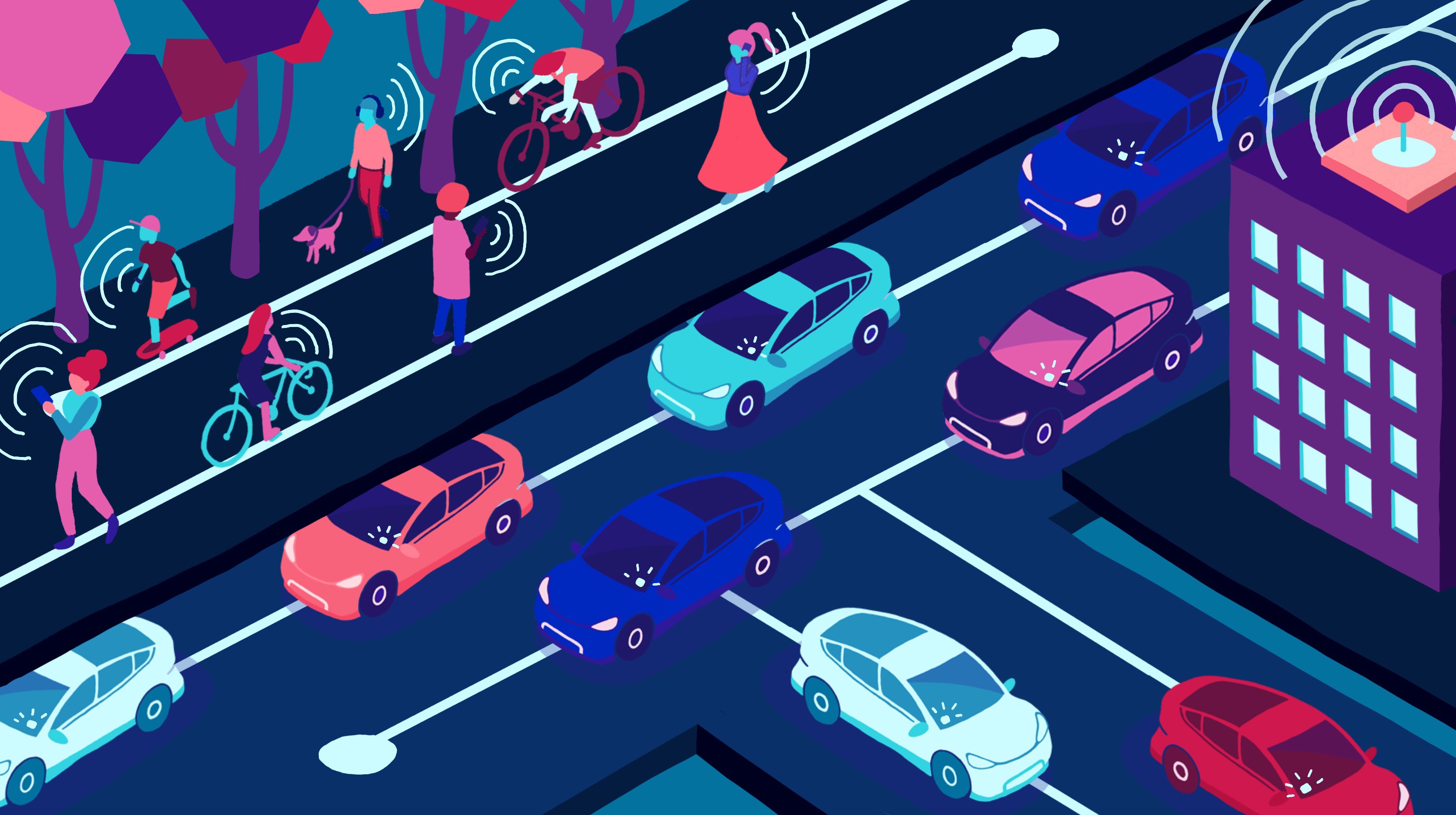
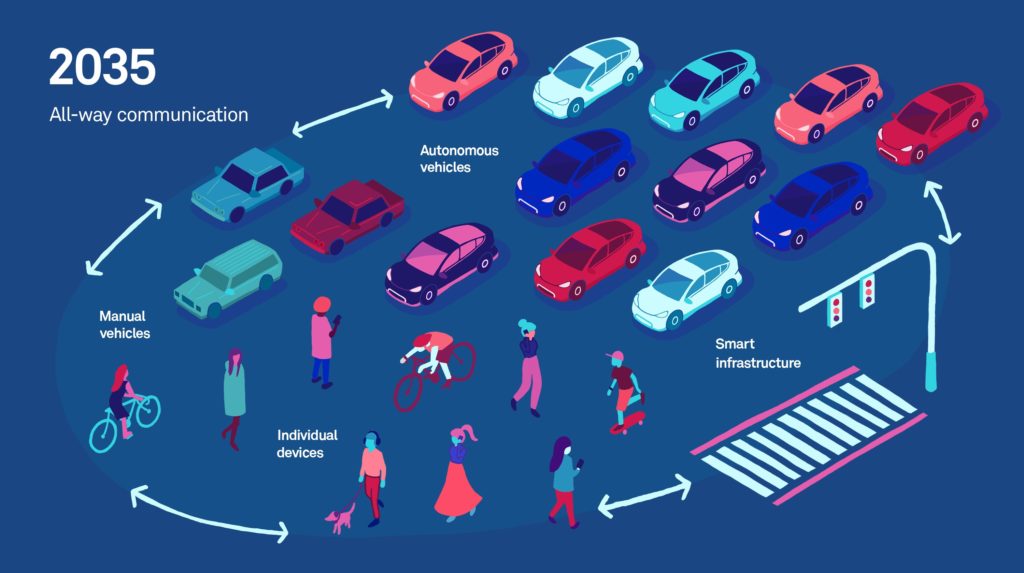
We examined how a long-term strategy could align multiple layers of devices, products, platforms, and environments to work together over the next 15-20 years and evolve as technology matures, policy advances, and infrastructure keeps pace. To illustrate this holistic approach, we envisioned how a single intersection might look in 2020, 2025, and 2035 to show how a systems-level strategy for autonomous vehicles would lead to safer outcomes for people, business, and society.
2020: Improved reaction
Within a few years, semi-autonomous vehicles will be able drive themselves in stable traffic and intervene if human drivers encounter dangerous situations. At a typical intersection, imagine that a pedestrian named Cassie absentmindedly strolls through a crosswalk during a red light because she’s focused on her phone. Driving along in his semi-autonomous car, Mike doesn’t see Cassie because it’s dark outside. Fortunately, Mike’s car detects Cassie in its path and self-brakes to avoid hitting her. At the same time, the corner streetlight senses Cassie illegally crossing the street. It illuminates the crosswalk more brightly and flashes warning colors to alert oncoming drivers. Cassie notices the warning illumination, looks up and sees Mike’s approaching car, and scurries back onto the sidewalk. In this situation, improved sensing systems and coordinated response are the first step toward an integrated system.
2025: Co-ordinated response
By 2025, autonomous vehicles that can drive themselves in most urban environments will share the road with both semi-autonomous and manual vehicles. While it will take some time to adjust to new driving customs and right-of-way, connectivity and regulation will help to lower the risk of collision. In this scenario, Cassie on her way to happy hour with friends. Having learned nothing from her near miss in 2020, Cassie is about to jaywalk during a red light and doesn’t notice the self-driving car that has turned into her path. Fortunately, the self-driving car is adhering to automatic speed limits and is traveling at a lower legal speed than manual vehicles and has enough time to detect Cassie. The car also pings an alert to Cassie’s phone, which instantly rings and replaces her messaging app with a warning screen. Noticing the warning, Cassie does not walk into the street with oncoming traffic. Through two-way communication, the self-driving car and Cassie’s personal device work in tandem to avert a collision. Here, greater degrees of connectivity between multiple devices and platforms increase the fidelity and performance of the system.
2035: Automated prevention
By 2035, public and private organizations will partner to fundamentally change the way we move about in cities. They will leverage data to reshape our urban environments, including separate zones and traffic rules for autonomous vehicles, pedestrians, and other modes of transportation. This time, Cassie is running late to a meeting and decides to cross a vehicle-only street to get to her destination. The first oncoming car triangulates Cassie’s movements by tracking her personal device. It predicts that she will soon be in its path and immediately stops. To avoid getting rear-ended, the car transmits a warning to all other self-driving cars on the street, directing them to slow down. At the same time, cars that are about to enter the street are re-routed by the city infrastructure to avoid congestion. Cassie eventually crosses the street, but does receive a ticket for her traffic violation and vows to do better in the future. In this phase of development, near-universal connectivity and integrated infrastructure will allow self-driving cars and cities to predict and mitigate potential risks, influencing behavior and creating preferable outcomes.
To enable this future, there will need to be significant alignment and collaboration between corporations, government, and society to ensure that our collective interests are prioritized over any single platform, product or technology. The journey begins now, while the technology is in its formative state, and before today’s decisions become tomorrow’s standards.
For the second year in a row and third time in four years, we’re thrilled to announce Artefact made Seattle Business Magazine’s Best Place to Work list! Making this list each year is becoming more and more competitive, but the competition only drives us to raise our bar so we can continue to better serve our employees, clients, and community.
Each year, we reflect on things that are going well and focus on areas needing improvement in the studio and in client work. We frequently ask our employees and clients for feedback and hold ourselves accountable to make changes to the areas that need to evolve. We understand, that in order to be prosperous as an organization, it is essential to take the time to listen to this feedback and act on it. The 100 Best Companies List means a lot to us because it is driven and determined completely by employee feedback, so to make it on the list means our employees are speaking up and sharing what they love about working at Artefact.
It is truly an honor to receive this recognition. This year, instead of writing about Artefact, we wanted employees to speak for themselves and share why they love working here:
I love Artefact because (just as with our client work) people are at the center of everything we do. I’m supported through mentorship, empowered to grow professionally and contribute to my community, and connected to my colleagues in fun and meaningful ways. We get to tackle interesting and diverse projects, and I’m especially proud of the work we do for social good and underserved communities.
Joan Stoeckle, Design
I like that Artefact is a small company that always tries to figure out how to change for the better. Most companies resist change until it becomes too late, but Artefact is always hacking itself. I’ve been at a lot of companies and this is the only one that I’ve worked at that is serious about self-analysis and growth. It’s truly a learning organization.
Sheryl Cababa, Design
Artefact attracts great projects and the amazing talent who want to change the world, learn from each other, elevate themselves and those around them. The company itself is an exercise in great user experience, looking at pain points and iterating our approach to create a culture where you can do your best work.
Jon Mann, Design
Artefact consists of a group of skilled, passionate, inspiring, well rounded individuals that are always motivated to learn from each other and have an impact in the community. We yearn for the challenge to craft amazing things and we look for opportunities to design for a better future. What makes us stand out from other organizations is that we genuinely care and respect each other. As an organization, we do all we can to support each other through career and life obstacles. We create opportunities and provide the right tools for our employees to thrive as consultants. The key to Artefact’s success is our people and we don’t take any of our talent for granted. We value the unique aspect each individual brings to the table, and together, we’re a stronger company for it.