Empathy is Not Enough: How to Take Action Toward Inclusion in Design
Design thinking has helped teams gain empathy and create better experiences for people around the world. Yet sometimes the experiences that result from design thinking processes benefit only the communities and populations that are directly engaged. At other times, it can be hard to advocate for empathy within organizations in a way that effectively informs design. How might we prevent exclusions related to safety, accessibility, and belonging that can result from our designs? How can designers take responsible, inclusive action against daunting, systemic challenges?
As part of the 2020 Seattle Design Festival, our Associate Strategy Director Felix Chang led a participatory session highlighting ways that designers and professionals can take action to increase inclusion through their work.
Attendees had the opportunity to break out into small virtual discussion groups to share best practices and brainstorm actionable ways to foster greater inclusion through the lenses of culture, mindset, and practice. These were some of the key take-aways the group generated together:
Culture
Inclusion is a human act. Establish relationships and build trust within your organization and with diverse communities. Start conversations, get to know people, and schedule one-on-one check-ins to learn about their personal life, not just their work.
Evangelize the value proposition of inclusion to organizations and specific teams to build momentum. Communicate the value in terms of both risks to avoid (i.e. lawsuits) and net-new benefits (i.e. increased market size, improved perceptions of brand).
Normalize and distribute responsibility and accountability for inclusion across the organization, not just for those with specific roles or identities.
Mindset
Retrain your brain to act and focus on impact, rather than intentions, when it comes to inclusive practices.
Make reflecting on exclusion and inclusion a habit. Regularly think about the biases and privileges you and your team bring to your work.
Consider accessibility and belonging when working in new mediums like mixed reality, before they are even built.
Practice
Strengthen communication by establishing and using common, agreed-upon language when discussing inclusion. Avoid using jargon or acronyms.
Create formal spaces to co-create with diverse folks and communities that meet them where they are.
Build in steps for quality assurance for inclusion throughout the product development process.
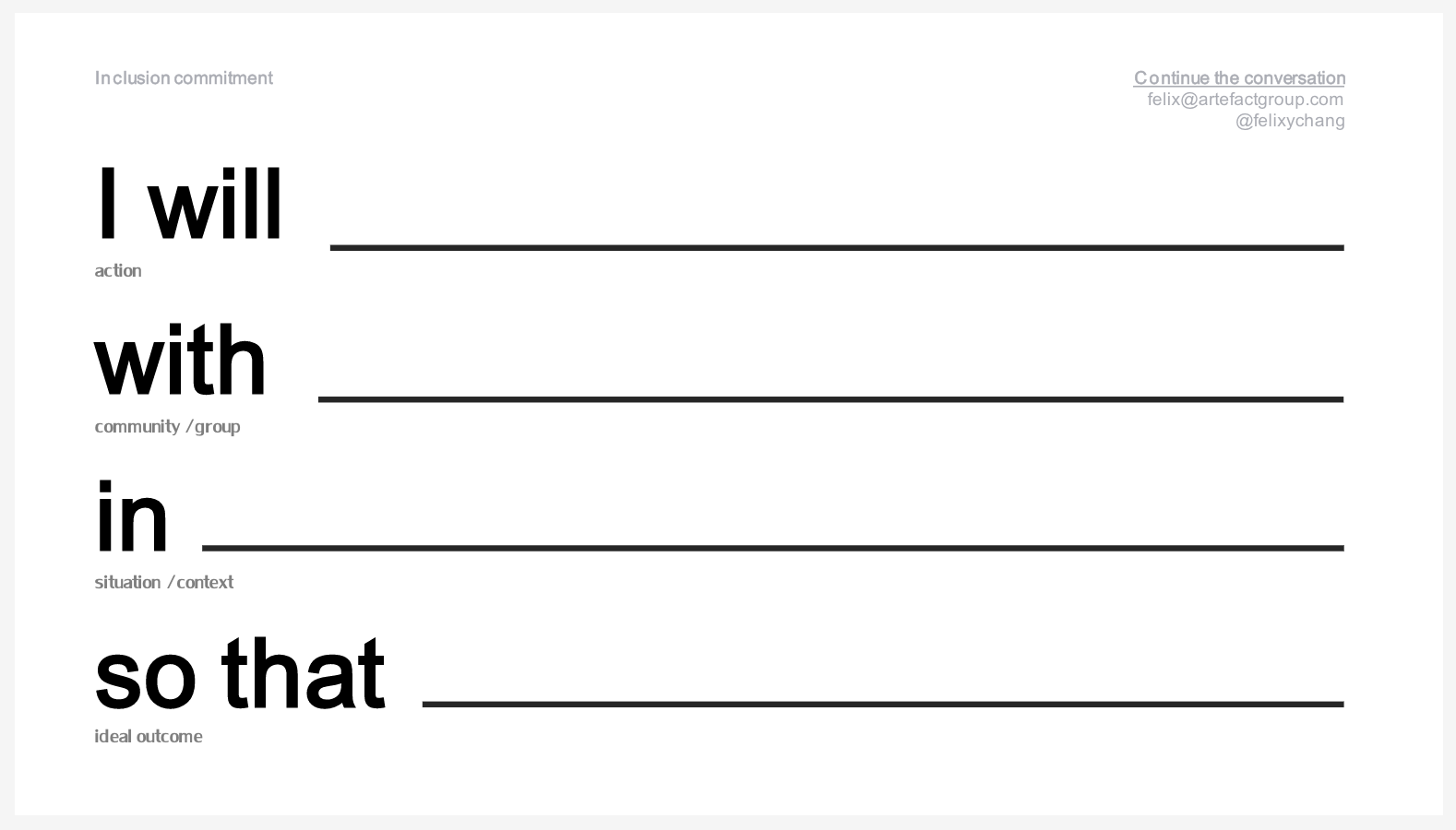
Attendees were then invited to make an inclusion commitment using the form below to put what they learned into practice. How will you work toward practicing inclusion in your team and organization?
To keep the conversation going, be sure to sign up for our Impact by Design event series.
While the future is always unknown, the pandemic has amplified our awareness of uncertainty, implicating many facets of life that were once thought of as enduring.
This series explores this altered landscape through the lens of critical uncertainties and narrative sketches of potential 10-year futures. These scenarios are not predictions – they illustrate a range of plausible outcomes that may help challenge prevailing assumptions, spark discussion, and inform more resilient strategies.
The strategic question
In light of the current pandemic, how might the future of mobility evolve in the US by 2030? Will the pandemic act as a catalyst for significant change, or will we observe a return to the norm?
The model
Mobility scenarios often focus on technology (e.g. autonomous, AI, electrification, etc.) and innovation/policy (e.g. new business models, regulation, etc.). Looking ahead, the mobility landscape may also be impacted by other factors we have previously taken for granted:
1. Norms regarding shared space and resources
How might policies and attitudes toward density, crowds, personal/public space, and shared resources/services affect mobility behaviors?
2. The future of work
How might changes in work – specifically the trend toward decentralized and asynchronous knowledge work and the “death of the office” – contribute to secondary effects that impact mobility?
The interaction of these dynamics leads to the following scenarios:
Four scenarios
1. View from 2019
Work is more centralized + Sharing increases
2030 looks a lot like we thought it might in 2019. Pandemic effects were relatively short-lived – with most people returning to old patterns of work and lifestyle once the virus was contained. The office remains the dominant paradigm for professional work and the car remains the primary means of transport around which everything else is built. In large and affluent cities, AI manages the commute for many, in concert with connected vehicles, ride-sharing services, increasing numbers of autonomous vehicles, and a smattering of micro-mobility solutions that come and go. More and more organizations are organizing their own solutions, and the company bus is simply an extension of the office. Poor neighborhoods, smaller cities, and rural areas are increasingly left behind, as access to stable and well-paid work declines, income inequality widens, and the middle-class contracts.
2. Urban Utopia
Work is more decentralized + Sharing increases
Work is a hybrid activity – taking place in new, shared offices, at home, and elsewhere, but still somewhat linked to geography. Large cities are still the nexus of culture and commerce. City planners moved aggressively during and after the pandemic to create more livable cites – closing off major roads to vehicle traffic and moving toward pedestrian and bike-friendly infrastructure. E-bikes and scooters are everywhere. Retail is thriving as a destination experience, while traditional office space is being converted into mixed-use spaces and apartments which are available as part of innovative and affordable sharing models that have increased access to housing. Delivery has become the dominant means of acquiring everyday goods. The automobile is increasingly irrelevant in the city but remains a necessity in the suburbs and beyond.
3. Solo Commute
Work is more centralized + Sharing decreases
As some experts predicted, the virus is still with us, although we have become adept at managing its impact. The initial experiment in remote work proved a mixed bag, leading many firms to create new workspaces designed to foster optimal levels of collaboration and productivity while maintaining new and sometimes elaborate hygiene policies. Cities are particularly dysfunctional, as mass transit ridership has declined, reducing revenue and thwarting needed improvements. Safer alternatives and micro-mobility have proliferated, exacerbating challenges with aging infrastructure and a car-centric world. Traffic is getting worse each year, and the suburbs are growing. Those that can commute by car do so, parking some distance from the office where they access autonomous company transit designed for individual privacy and cleanliness.
4. Rural Shift
Work is more decentralized + Sharing decreases
The effects of the pandemic have been deep and long-lasting, particularly in terms of attitudes toward public/private space, density, and perceived safety. The office is dead. As more companies adopted remote, decentralized and asynchronous work policies, many people migrated from coastal cities to more affordable and less congested locales – breathing new life into small towns as large cities have struggled. Along with work, everything that can happen online does, including higher education, which has become increasingly vocational. The talent economy has created both opportunity and disruption. The economic effects of the early 2020s have lingered – inspiring new priorities and less conspicuous consumption. Even so, personal vehicles are a symbol of the utility they provide and the lifestyles they enable. Fewer people are flying, and the road trip is back.
Looking Ahead
This framework rests on various assumptions – for example that the percentage of people able to work remotely will continue to grow (currently estimated at ~40%). In a future where roughly half of workers are remote, it goes without saying that the other half will need to get from A to B much like today. Likewise, a wide range of services and experiences will require physical presence regardless of how the pandemic plays out.
Even so, the impacts are potentially significant. These scenarios aim to explore the edges of what is possible and the dynamics at play. In some ways, 2030 will look like today, and in other ways it will be quite different – the question is in which ways, and to what extent. Will you load groceries in an electric SUV, receive delivery by drone, ride an e-bike to the market, hail an autonomous shuttle, or take public transit? Yes, probably.
Artefact stands in solidarity with the Black community as an ally in the fight against inequality and injustice. The fundamental mission of Artefact is to create a more equitable and sustainable world. Combating individual and systemic racism is everyone’s responsibility, and we take this mission seriously.
We have spent the past weeks listening, learning, and continuing to examine how we can do better as an organization and community. Inclusion is a foundational value of Artefact, but we must and will do more. We are strengthening anti-racism practices within our organization, as well as continuing to advocate for equity, inclusion, and justice in our craft through responsible design.
I want to reiterate that we are listening. Please share with us any feedback on how we can engage with our community and industry to be more equitable and inclusive.
Thank you,
Rob Girling, CEO
We encourage you to join us in learning from the voices of designers, creatives, and strategists who have been committed to growing and sustaining this movement:
Antionette Carroll, Founder and Executive Director of Creative Reaction Lab, explores in this talk how creatives have the ability and responsibility to use design in crafting a more just world.
In this panel, photographer Carrie Mae Weems, architect Sir David Adjaye, and Professor Sarah Lewis discuss how the creation of space and institutions can challenge societal understanding of justice and identity.
An introduction to Equity-Centered Community Design, a process and framework by the Creative Reaction Lab that aims to deliver more equitable and just outcomes through design.
A virtual conference on June 27 to connect and elevate creatives of color and spark conversation around representation in the design community. The event is open to all professionals.
Event
Designing Digital Community for a Remote World
This webinar is part of our Impact by Design events series. In the face of the COVID-19 pandemic, we’re all experiencing new ways of communicating, collaborating, and problem-solving. At Artefact, we want to share the experiences and insights that we are learning as we navigate this new terrain with our partners. Join us in exploring how to use design to adapt to uncertainty.
Baobab is a digital social learning platform for African students who are part of the Mastercard Foundation Scholars Program. Designed by Arizona State University and Artefact, it provides learning tools, mentorship, and opportunities to connect and collaborate with other Scholars across the continent.
Baobab has been a key tool to help students who can no longer access their campuses due to the evolving COVID-19 pandemic continue their learning. In this virtual session, Artefact’s Eric Croskey and Bethany Weigele of Arizona State University discuss how the Baobab platform pivoted to deliver learning content in new ways, and the features and modalities digital communities need to help people engage, learn, and collaborate in a remote world.
This webinar is part of our Impact by Design events series. In the face of the COVID-19 pandemic, we’re all experiencing new ways of communicating, collaborating, and problem-solving. At Artefact, we want to share the experiences and insights that we are learning as we navigate this new terrain with our partners. Join us in exploring how to use design to adapt to uncertainty.
Decision-making is often fraught with uncertainty. How can we adapt design principles that support clinical decision-making to navigate the ambiguity facing public health today?
In this webinar, Artefact Executive Creative Director and Healthcare Practice Lead Matthew Jordan and Kaiser Permanente Washington Health Research Institute Associate Investigator Karen Wernli explore how design can support the clinical decision-making process with data in the face of uncertainty.
The conversation draws from the Artefact-KPWHRI partnership designing the SIMBA decision aid app helping breast cancer survivors make informed choices about their breast imaging options. Discover key design principles that can inform our approach to the current pandemic – and future public health issues.
Remote Reality: How to Adapt Methods and Maintain Momentum for Workshops
Image courtesy of Splash International
This webinar is part of our Impact by Design events series. In the face of the COVID-19 pandemic, we’re all experiencing new ways of communicating, collaborating, and problem-solving. At Artefact, we want to share the experiences and insights that we are learning as we navigate this new terrain with our partners. Join us in exploring how to use design to adapt to uncertainty.
International development organization Splash and Artefact partnered to facilitate a three-day strategy summit for their girls’ menstrual health programs in Ethiopia and India. Convening the world’s leading menstrual health experts, the original intention of the summit was to set a vision, strategy, and defined roadmap for Splash’s menstrual health interventions. Due to the evolving COVID-19 pandemic, Splash and Artefact pivoted the event into a virtual summit with clear, actionable next steps for all 30 participants across several different countries.
In this webinar, Artefact Design Director Hannah Hoffman sat down with Emily Davis, Program Manager for Menstrual Health from Splash, to share three principles that guided us in adapting design thinking methods for success in a remote environment. Learn actionable strategies for adapting your work that will serve you in our current remote reality – and the future to come.
Dear Clients, Design Community, and Artefact Family,
We have been closely
monitoring the Coronavirus 2019 (COVID-19) pandemic and wanted to send out a
note to our community about what we are doing and how we have been updating our
procedures based on recommendations
from the Center for Disease Control (CDC), as well as state and international
agencies.
As always, our first priority is to protect the health of our clients, employees, their families, and those in our community.
Additionally, we want
to continue to pivot our working styles and collaboration methods so that we
can do our part to slow community transmission of the virus while continuing to
deliver the highest quality work.
In order to achieve this, we are following guidance for social distancing and beginning last Thursday, we recommended that all Artefact employees work virtually, from home until at least April 24, 2020. Pending changes in recommendations from the CDC and local public health organizations, this date will likely be extended. As a digital agency, we are fortunate that all our tools and services are cloud based and that we’ve experienced minimal disruption moving entirely to a telecommuting posture. We are encouraged to see our staff exercise considerable creativity in how they are utilizing tools in order to effectively collaborate, design, and run workshops while working remotely with our clients.
We also stopped all domestic and international work travel until further
notice. Our studio is in the epicenter of the US outbreak and we find ourselves
in a position of needing to make responsible choices to reduce the spread of
COVID-19.
If you are a current client, you may have already seen or heard about these changes in how we are conducting business and we want to say thank you in advance for your adoption of these working styles given the volatile state we are all in.
We’ll continue sharing updates on the COVID-19 situation as they
evolve. If you have questions, please reach out to shauna@artefactgroup.com.
Stay safe and healthy,
Rob Girling, Co-CEO
Gavin Kelly, Co-CEO
Community
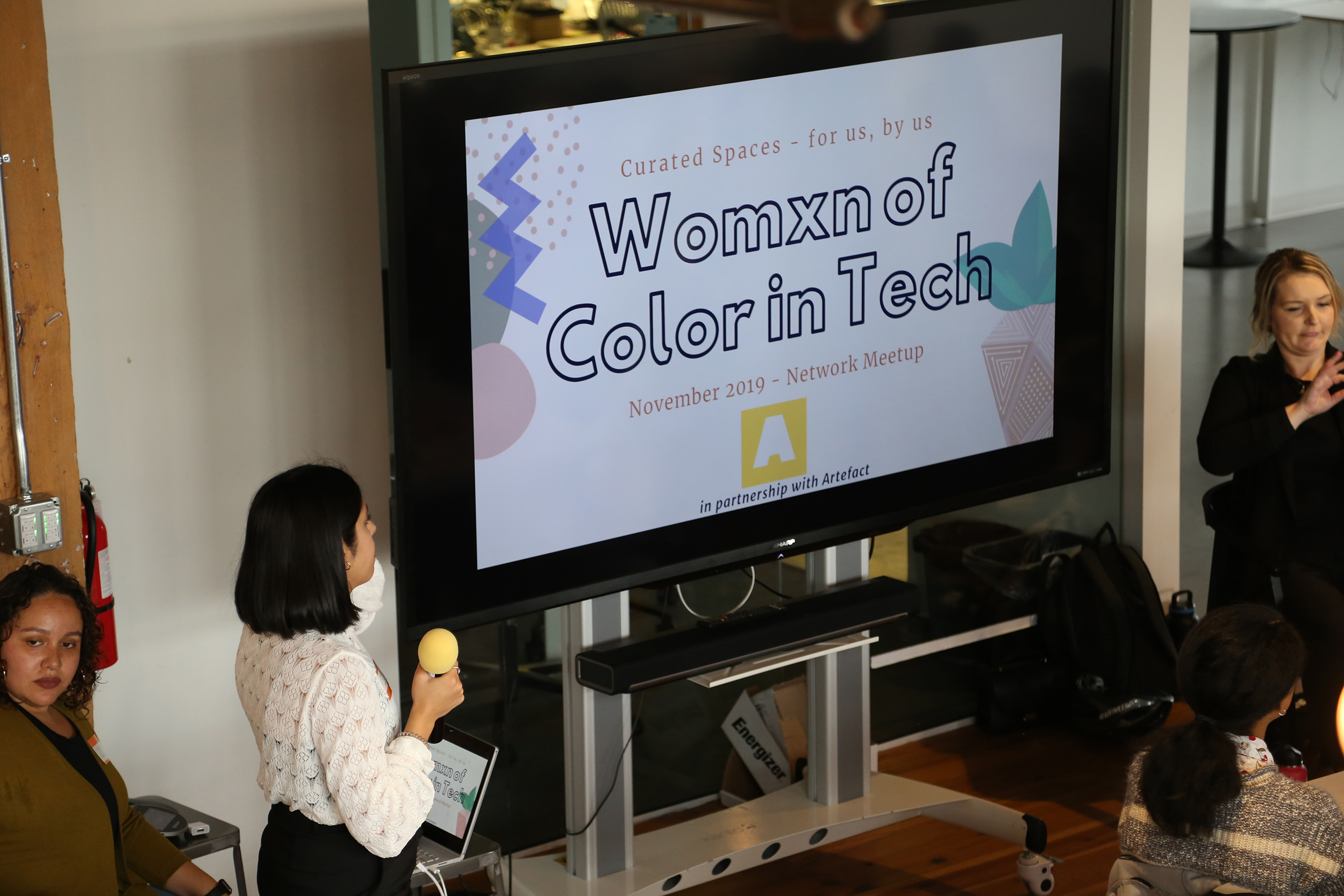
Artefact + Womxn of Color in Tech
It started with the need to create space. Space to be yourself. Space to tell your stories. A place to find connections and build community.
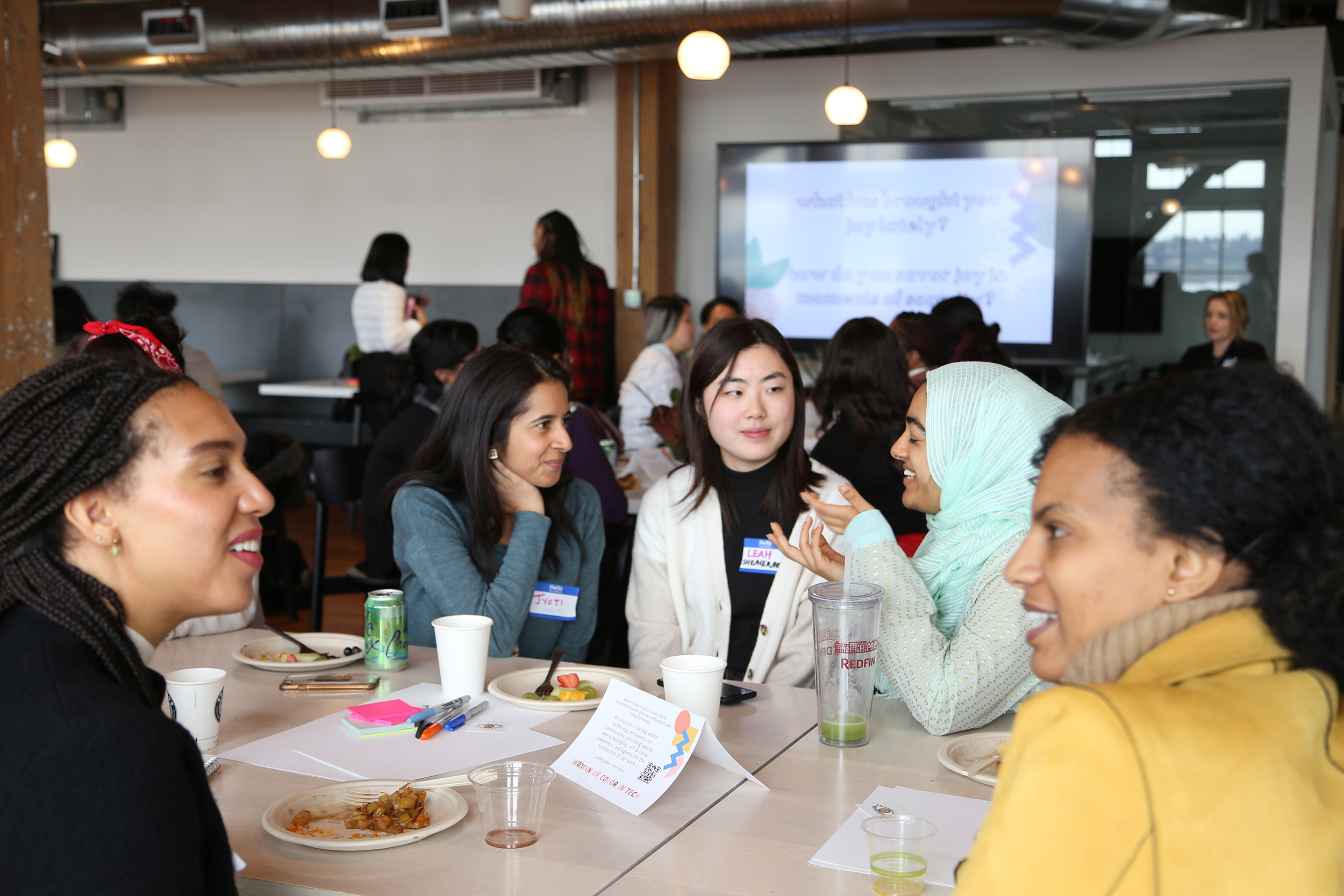
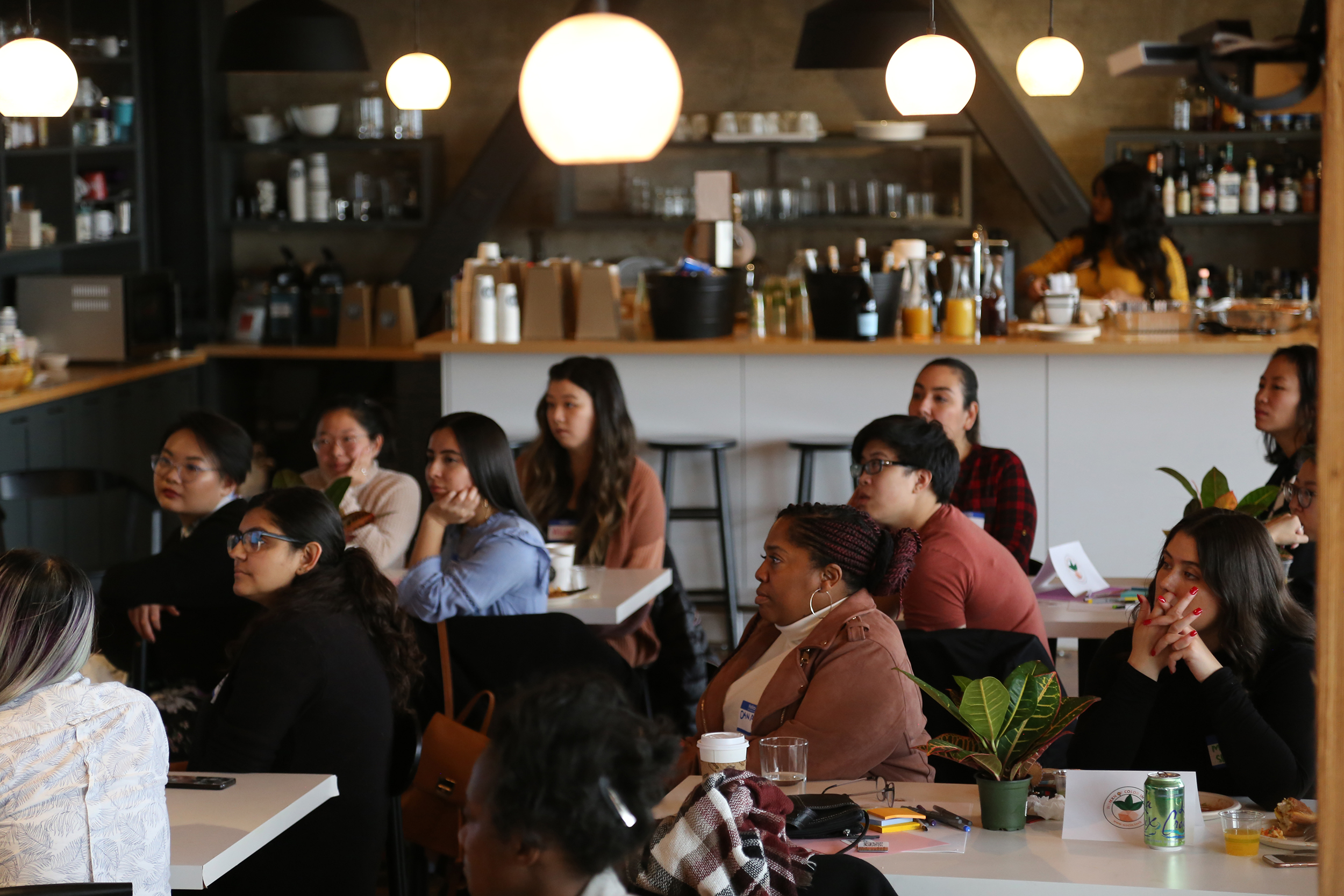
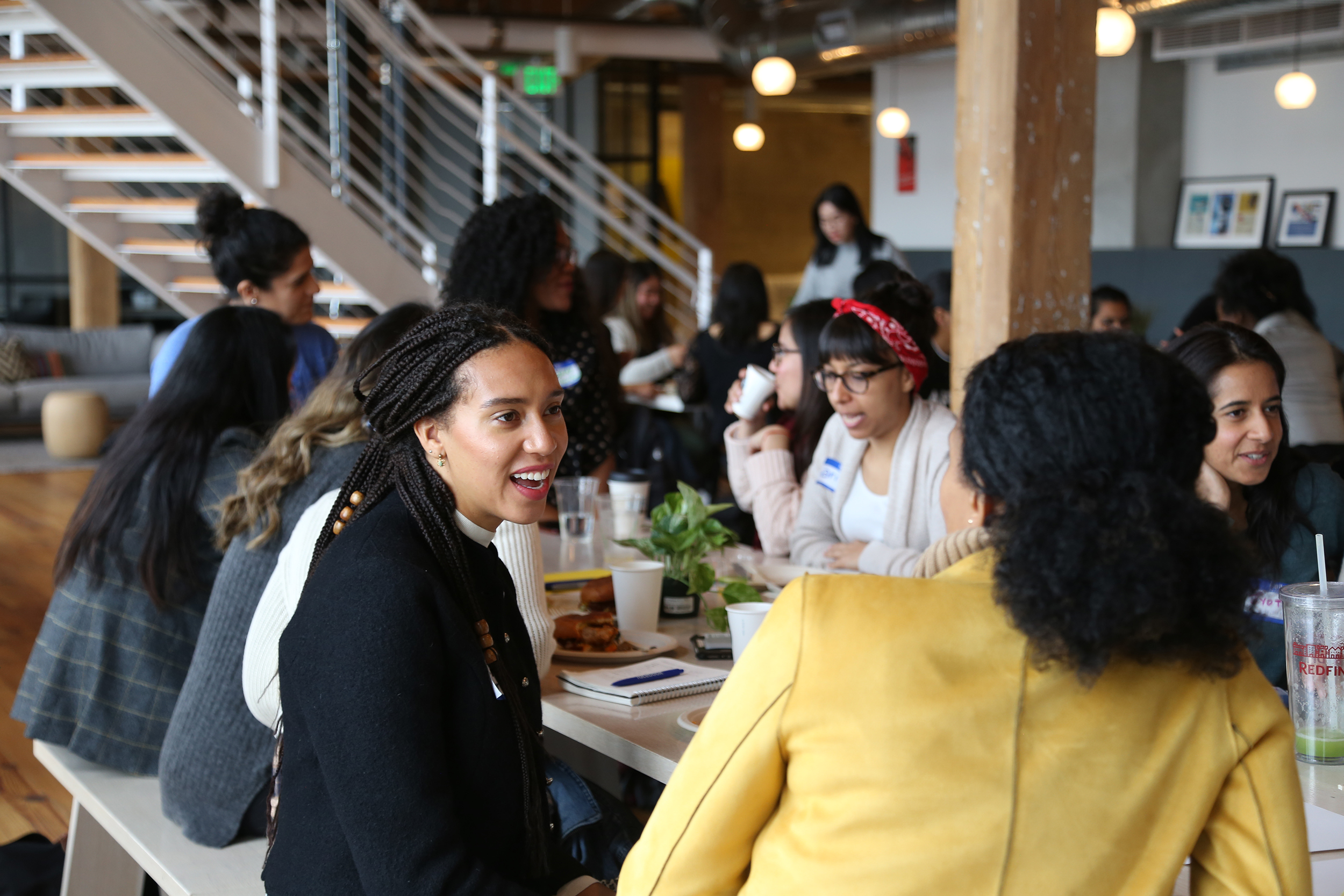
This November, Artefact was delighted to partner with Womxn of Color in Tech to host a meetup for our community. We welcomed 65 women of color to the studio to talk tech and social justice – the first event of its kind for Artefact.
Womxn of Color in Tech is on a mission to cultivate spaces and programs that explore and design a world of technology that centers around womxn, grrls, and communities of color. I was thrilled to meet founder Janell Jordan, as one of my goals at Artefact this year is to help foster a community for women of color.
Working at Artefact is the first time in my career where I’ve had a woman of color as a mentor, and the first place I’ve worked where someone has advocated for me as a woman of color. It has changed how I see myself and how I show up in the workplace. I wanted to create a space for others to feel the same.
In the tech industry, women of color are often in environments where our peers or those at the leadership level don’t reflect us. We don’t have the space to talk about our shared experiences, reflect, and get advice from one another.
An understanding of “space” guided our intentions for the day – from opening with a moment of gratitude for the Duwamish tribal land we inhabit, to ensuring all participants were empowered to participate through accessibility support like ASL interpretation.
The meetup centered around creating a welcoming place for women in tech from different backgrounds and in different places in their careers to connect with each other. We shared experiences – positive and negative – and explored ideas around creating allyship and workplace support. The day was filled with inspiration, mentorship, and empowerment – all set to a soundtrack of strong women artists of color.
One of the topics we touched was on what brings you happiness and how you hold onto it. I’ve thought back to this meetup often as one of those moments. I think about the people I met, the stories shared, and the feeling of being able to show up as our true selves at that moment. In an industry where we often feel isolated, there are other women of color out there looking – and making space for – the community.
I look forward to continuing Artefact’s partnership with Womxn of Color in Tech and am particularly excited to support a youth program that will bring young women of color to our studio next year to job shadow women at Artefact.
“Had a blast at the WOC in Tech meetup this weekend. I learned a lot. I loved meeting new people and hearing about their experiences and how they got to where they are now. I need to go to more things like this!”
Meriel M. – UX Designer
“What a great time sharing experiences and finding solutions to bring down barriers in the workplace related to diversity and inclusion. Met some amazing and inspiring women today, and I’m looking forward to seeing what else Womxn of Color in Tech will be working on!”
Lita G. – Systems Engineer
“I can’t stop thinking about the women I met at the Womxn of Color in Tech Summit last week at Artefact. Their stories, some as traumatizing as my own in Corporate America, assured me that I’m not alone in the struggles we’re facing daily to EXIST in spaces we may not always feel we belong in or sometimes not gracefully welcomed into…I hope more black women and women of color continue speaking up and out so things will continue to change and get better.”
Designing with – not for – the Changing Face of Global Health
Sheryl Cababa
“How do we integrate human-centered design in
problem solving for global health?”
This was the question posed at the Gates Foundation and USAID human-centered design and global health convening: DesignforHealth: Nio Far Dakar. In Wolof, “nio far” means “we are together.” It was an appropriate title to the gathering, which brought together more than 70 invited design practitioners and global health experts from the world over for three days of reflection, ideation, and strategy.
As a host city, Dakar is the perfect venue for discussions about the future of human-centered design. The city is rapidly changing, from its loss of public spaces for children, to its role in Chinese investment in the region, to its importance in modern African art. The conference took place at the beautiful new Museum of Black Civilisations, which opened in January 2019. As a venue that is reflective of a changing Africa – and partially funded by the Chinese government – it is symbolic of how our global future is moving from north to south, and from west to east.
Over the course of the convening, we broke out into five “missions” to envision the future of human-centered design within global health: achieving scale, creating a design curriculum, managing design, understanding the return on design, and developing integrated approaches. Each mission had a mix of design practitioners and global health experts from organizations as diverse as PATH, McKinsey, Nairobi Design Institute, and the Clinton Health Access Initiative.
Working through these challenges with my peers in design and subject matter experts left me with three key takeaways on designing for global health.
1. Understanding global trends helps shape our thinking on the future of our design practice.
To kick off the workshop, Mari Tikkanen of social impact company Scope introduced trends to think about as we consider our mission of using human-centered design in global health. Urbanization, changing demographics, and transformative tech were key themes, all of which are affected by our changing climate. For example, I learned that there are currently about 19 megacities (a city with a population of 10 million or more). By 2030, there will be an additional eight megacities, all but one of which will be in Asia and sub-Saharan Africa. In order to engage in human-centered design, we need to better understand cultures and ways of working in the global south as this is where we can have the greatest impact on global health. A Western lens on global problems is no longer enough.
2. User-centered design (UCD) is not equal to human-centered design (HCD).
Engaging with a group of talented human-centered design practitioners reminded me how often the tech industry uses the term “human-centered design” while actually practicing “user-centered design.” The difference matters. When we are solving for large-scale problems that touch many different stakeholders, the person who “uses” a design solution is just one stakeholder. Human-centered design should take the entire context into consideration, including those who may not be direct users. For example, with medical devices used in hospital settings, it may be hospital administration that has a greater influence on a device’s use than direct users. Examining the outcomes of our solutions on a broader set of stakeholders helps us develop programs or products that have fewer negative externalities and the most positive impact.
3. Want to be more inclusive? Engage in co-creation.
As we spoke about how to create a design curriculum, the conversation revolved around investing in design as part of in-country global health programs. It reminded me of an exhibit at the Gates Foundation Discovery Center called “Design With the 90 Percent” that explores designing for marginalized communities. “With” is the operative word here: what does it mean to design with those who are the beneficiaries of our design work, rather than designing for them? It means engaging in the hard work of helping non-designers contribute to our designed solutions. In designer Chris Elawa’s excellent article “Stop Designing For Africa,” D-Rev CEO Krista Donaldson says, “Without immersion with users, without being in-situ, without a sense of culture, language, norms, and deep understanding of the problems faced , an iterative product development process slips from market-pull to technology push.” In other words, we need to understand the human need first, and what that requires is help from the humans whose problems we are helping to solve. Some ideas for greater inclusion: investing in cultivating in-country design expertise and training on-the-ground community health care workers in design thinking skills and processes to help them innovate in their work.
As we see a convergence of technology,
healthcare, and non-Western centers of power, we can use human-centered design
to inform a shift in thinking. In order to be able to respond to the pace of
global change, let’s ask ourselves, “How might we apply a creative approach to
large-scale emerging health problems?” The world can’t afford to wait.
It’s not every day
that you get to meet an icon. I had the opportunity to speak with a personal
hero of mine last week, indomitable tech journalist Kara Swisher, who was in
town giving a talk Artefact organized in partnership with Seattle Arts and
Lectures. As witty and wry as ever, her conversation revolved around the pertinent
themes of technology usage, industry regulation, and some pointed commentary on
Jack Dorsey’s beard.
In reflecting on Kara’s lecture and recent high-profile criticism of the tech industry, however, I got to thinking about the current all-or-nothing approach to technology in our culture. The general response to Big Tech’s many missteps has been to run away from it – be it by limiting our screen time or scrambling to #DeleteFacebook. This abstinence-only reaction is dangerous because it doesn’t help us understand how to relate to the ubiquitous technology in our lives. Rather than retreat from technology, we need to figure out how to coexist with it. I’ve been thinking about our evolving human relationship with technology in three ways:
1. Governance and technology need each other.
From airbags to the Internet, technological innovations often
wouldn’t exist or thrive without government investment, subsidy or governance.
When we look across the Pacific to China, we see a state that is investing
heavily in tech and is extremely innovative. More
often than not in unethical ways.
When it comes to tech oversight, Silicon Valley has long
pushed the narrative that they are the good guys in a struggle between American
tech interests and authoritarian foreign governments – “It’s Xi or me,” as Kara
put it, in reference to Chinese President Xi Jinping. This fearmongering has
scared politicians into thinking that we should not regulate the U.S. tech industry
for fear of becoming the kind of Big Brother state we see elsewhere in the
world.
Yet we can’t accept that logic at face value. We don’t want authoritarian states running the next information age, but we also must question ourselves and Silicon Valley on the products we create and how they impact society. The conversation won’t be easy for the tech industry or government. Throughout history, industry in the U.S. has been bad at regulating itself (we only need to look at how dangerous food used to be before regulation as an example). However, one thing we often forget is that government support and intervention often spurs innovation. Elon Musk, for example, received $5 billion in funding from the U.S. government to finance SpaceX, Tesla, and Solar City. The tension between Silicon Valley and regulatory bodies is only when they fear regulation will keep them from amassing huge concentrations of wealth.
2. Beware of “benign” organizational culture.
There’s an important connection between the perception of
tech companies as having a “harmless” organizational culture and the lack of
regulation in the tech industry. We don’t hear about this relationship as often
as we should. Kara touched on the infantilization of Silicon Valley leadership
and the misguided notion that they’re just a bunch of kids tinkering in
garages. In truth, they are some of the most powerful individuals in the world
making decisions that affect billions of people across the globe. Just because
they wear hoodies and flip flops and don’t look like a Wall Street executive
doesn’t mean they aren’t as powerful – or savvy.
In Artefact’s social
media systems map, we identified how “organizational CULTure,” as we call
it, affects the design of social networks. The idea that technology is neutral –
and the lack of priority around fixing the problems facing social media – has to
do with an organizational culture devoid of diversity at the leadership level.
So many of tech’s decision-makers have not been personally touched by the
negative impact of their products or suffered as much as other people have at
the hands of their creations. Sri
Lanka and Myanmar
come to mind.
Of course, we need the skills and talents of tech leaders to work toward solutions, but they currently do not have an incentive to improve a harmful experience that they have not had – and will never go through – on their platform. In fact, they profit from this lack of intervention. We need to expand our definition of stakeholders. We need to bridge the gap between Silicon Valley and those who don’t have a seat at the table yet bear the brunt of its negative consequences. We also need to treat leaders in tech as the formidable industry titans that they are, and hold them responsible for the outcomes of their products.
3. Social media is not equivalent to climate change.
I’ll be the first to criticize social media for its negative
consequences in the world, but I’m starting to feel fatigued by the
vilification of social networks as the root cause of all of our problems.
Particularly when this criticism comes from those who have a vested interest in
cooperating with the tech industry.
The argument that all of the tech industry’s problems have
to do with the attention economy are starting to become platitudes. Cable TV
brought us ideological news programming. Traditional media were gatekeepers to
information. We can’t forget that the world was imperfect before social media.
These platforms are exacerbating existing problems, and it is dangerous to
ignore the exogenous or underlying factors that are driving issues like bullying
and disinformation campaigns online.
We start to discount our own arguments when we fail to
acknowledge what might be positive about having social networks. Online
communities have helped marginalized people find and support each other. Black
Twitter, for example, is an important outlet that gives many people a voice
they had not had before. I get value out of social networks that help me learn
from people I don’t normally interact with in real life. I can’t invalidate the
entirety of these social media experiences. It’s starting to feel like we’re
throwing out the baby with the bathwater.
Rather than discount Big Tech altogether, let’s work to design products responsibly, embrace
thoughtful regulation, and shape our individual usage in healthy and productive ways. Technology
doesn’t have to downgrade humanity – unless we let it.