We are still in the early days of virtual, augmented, and mixed reality (a continuum increasingly known as XR). Most devices today still feature a limited field of view, a maze of cords, and controls that are difficult to master. There’s work to be done to better understand and develop these technologies, their user experiences, and product impact. Yet try on the Magic Leap One or Oculus Go, and the vast potential of XR becomes clear.
From consumer electronics to retail to finance, Artefact’s clients across all different industries are asking where XR is heading and how they can leverage it for their business. For the most part, they are asking the right questions, such as how XR will deliver value by catalyzing the engagement of new customers to drive sales. But that’s just the tip of the iceberg.
Rethink the possibilities
Although the hype around XR frequently focuses on immersing users in new or enhanced worlds, the power of XR is rooted in something more profound. XR helps us transcend the limits of the human experience and fulfill our highest ambitions. In other words, it gives us superpowers.
Soon, XR will expand our access to information as well as our day-to-day relationship with it, including the intelligence we draw from it. It will also close the delta between real and digital dimensions more generally, helping us think differently about ourselves and our communities, who we aspire to be and what we’re truly capable of achieving.
Organizations can tap into the unique superpowers of XR in novel yet on-brand ways that help transform customer experiences and product value. By unpacking each, we better understand how — so let’s explore:
1. Teleportation
The first superpower is teleportation — helping us strengthen connections to people and places without enduring a long plane ride or additional costs. Today, I can use XR to participate virtually in meetings anywhere in the world using products like AltspaceVR, or plan my vacation by giving the cenote pools in Mexico a test visit through Expedia. Such applications are increasingly commonplace and exciting new ones continue to surface. Imagine if online education platform Masterclass not only created video tutorials from chef Gordon Ramsay, but enabled me to cook alongside him from the comfort of my own home in Seattle. Or better yet, what if I could see and interact with my mom in her kitchen in Virginia as we bring a complex recipe to life?
2. Context shifting
The second superpower is context shifting — helping us walk in someone else’s shoes and live out their experiences in ways no other technology can do today. XR transcends the escapism of a good movie or other forms of entertainment. Using XR, the trauma of racism or the plight of US prisonersand refugee populations is illustrated in ways that are more immersive and intimate, deepening our empathy and understanding of lived experiences that are different from our own. This superpower also enables powerful healing applications like exposure therapy for war veterans who suffer from PTSD. Now imagine what healthcare providers could achieve if they leveraged it in their communications with vaccine skeptics who underestimate the threat of preventable diseases and the importance of vaccinating against them.
3. Omniscience
The third superpower is omniscience — helping us access all the world’s information at a moment’s notice. From using Google Glass in surgical settings to CourtVision during a basketball game, XR technology is expanding people’s access to real-time information and the intelligence derived from it. Now imagine how XR could help Tableau provide real-time data analyses to their customers, for example, when their customers are exploring the answers to complex problems with peers, including during the Q&A portion of conference presentations.
4. Enhanced creativity
The fourth superpower is enhanced creativity — helping the ideal products of our imagination come to life, even enabling others to respond to them. With XR, decisions that would previously take me and my husband months to make together, such as what color to paint our house or what new kitchen configuration would better suit our growing family, are dramatically simplified. The time and cost gap between imagining and creating goes to zero. IKEA is already using this technology to facilitate customer collaborationin a manner that not only expands but also personalizes product value. It isn’t a stretch to envision the same technology helping me design a custom Louis Vuitton bag with their signature elements similar to Burberry’s Bespoke web application — if someday I had extra cash to burn!
Redefine the future
Before exploring newfound applications and thus the business value that XR might create, it’s incumbent that organizations first recognize why people seek to immerse themselves in XR, and what they will need for their experience in it to be authentic. The frame of superpowers can help because it pushes us to think beyond technology for technology’s sake. In addition, our desire for superpowers is technology agnostic. It’s deeply human to want to better connect with others, more quickly access and process information, and ultimately build something of lasting value. When organizations leverage the unique powers of XR to help customers realize these human aspirations, the net effect is XR helping us not only aspire to be, but also become, our better selves — individually and collectively.
Artefact joins Seattle mayor’s new Innovation Advisory Council
Artefact is honored to serve Mayor Durkan and the people of Seattle as a co-chair of the first-ever Innovation Advisory Council (IAC), a new collaboration between the tech sector and local government that aims to harness the power of technology to help solve the city’s most pressing problems. From homelessness to transportation and mobility, the IAC will advise on issues affecting the city as well as assess and propose where data and technology solutions could be of benefit.
“Seattle has always invented the future, and companies like Artefact are essential to the Innovation Advisory Council and its development of technology solutions that will help our city address our most pressing challenges. By utilizing Artefact’s responsible design approach, we will create a better future together,” said Mayor Durkan, who launched the IAC through Executive Order at a press conference in downtown Seattle.
To the role of co-chair, Artefact—the only design firm on the IAC—will contribute our world-class product and systems design thinking to help Mayor Durkan and the City of Seattle reimagine opportunities at the intersection of technology, product innovation, shared value, and social impact.
Our fellow co-chairs include Expedia, Tableau Software, and Technology Access Foundation. Other members of the council include Amazon, Flying Fish, Microsoft, Washington Technology Industry Association, and Zillow Group.
A big thank you to Mayor Durkan for including Artefact in your vision for shaping a better tomorrow. The issues are as urgent as they are complex, but we are eager to shape newfound strategies and solutions that help make a difference for all who call Seattle home.
Twice a year, Artefact employees take 24 hours to team up for the Artefact Hackathon to see what they can create using everything from open source software to pipe cleaners. At the end of the 24 hours, we are always left with a giant mess, leftover pizza, mild sleep deprivation, and many, many awesome ideas.
Our latest Artehack was no different. Each team rose to a unique challenge, resulting in everything from a Roomba built for disaster relief to an AI-enabled confessional for the future. However, two Artehack projects tackled a subject particularly close to us as a company: alleviating homelessness. As part of the Seattle community, Artefact is invested in finding ways to improve the homelessness crisis, such as our partnership with the Seattle Mayor’s Innovation Team to create solutions for homeless youth. These two hackathon projects are just prototypes, but demonstrate that people can use design thinking to solve tangible problems as part of tackling the larger challenge of homelessness.
How might we cut down on food waste and increase food bank donations?
Grocery stores and supermarkets account for 16 billion tons of food waste per year, much of which is perfectly good food cleared off shelves for stocking purposes. Meanwhile, food banks and homeless shelters depend almost entirely on donations, with little way to control what food they receive and when they receive it. One hackathon team wondered: What if food banks could proactively request the kinds of food they need and connect with grocery stores clearing stock?
A pile of foamcore and a handful sensors later, the team created an program that allows food banks to select and receive the kinds of necessities and food they need most. Food banks use an app to select their most needed food items, and the app pushes the request to local grocery stores, who can then place the items in a cart. Once the lid on the cart is closed, sensors within the cart push a notification to the organization that their food is ready for pick-up. The food bank can key in an access code on the cart and receive fast, local, and fresh food donations.
How might we make it easier for people to help the homeless?
Although the goal for many homeless people is long-term access to housing and resources, there is huge demand for necessities and essentials that can make daily life easier and safer. At the same time, we know that many Seattle residents often feel at a loss for how they can make a difference given the size and scope of the homelessness crisis in Seattle. The intersection of these two issues inspired one hackathon team to create The Bene Program, a giving campaign that empowers people to fund tangible items that help the city’s homeless population.
Here’s how The Bene Program would work: pick up a Bene Card at a local retailer and top it up with a pre-paid amount. As you go about your day in the city, you can tap your Bene Card on customized card readers around town that promote the funding of specific programs and essentials. For instance, tapping your Bene Card at the dog park would fund food and care for the pets of homeless people, tapping at the bus stop would help fund transit cards, and tapping your Bene Card in a public restroom would fund hygiene products. At convenience and grocery stores, Bene Card donations would fund essentials and food being placed into the Bene Box, a cabinet accessible for the homeless to take things like food, water, and first aid supplies. Use the companion app and website to check your donation totals and top up your balance, and participating organizations can use the card system to arrange for corporate donor matching. The result would be direct, community-based fundraising that makes it easier for Seattlites to provide resources and essentials for neighbors in need.
Hackathons always leave everyone at Artefact with a few new skills and good inspiration to take into our design work. This hackathon was no different, and we are heartened by the creativity and thoughtfulness each team brought to their challenges. We may not have finished final products, but both the food bank cart and Bene Program prove that all you need for a good idea is some hot glue and great teamwork.
Using self-driving cars to roadmap a safer transit system
When most people imagine a safer future involving autonomous vehicles, the thinking is often focused on the capabilities of the cars themselves, varying levels of autonomy, specific safety features, and the passenger experience. However, if we look beyond the car to include the many players and platforms involved in the transportation system as a whole, a more significant opportunity emerges: the chance to design a fully integrated solution that gets better as the network grows.
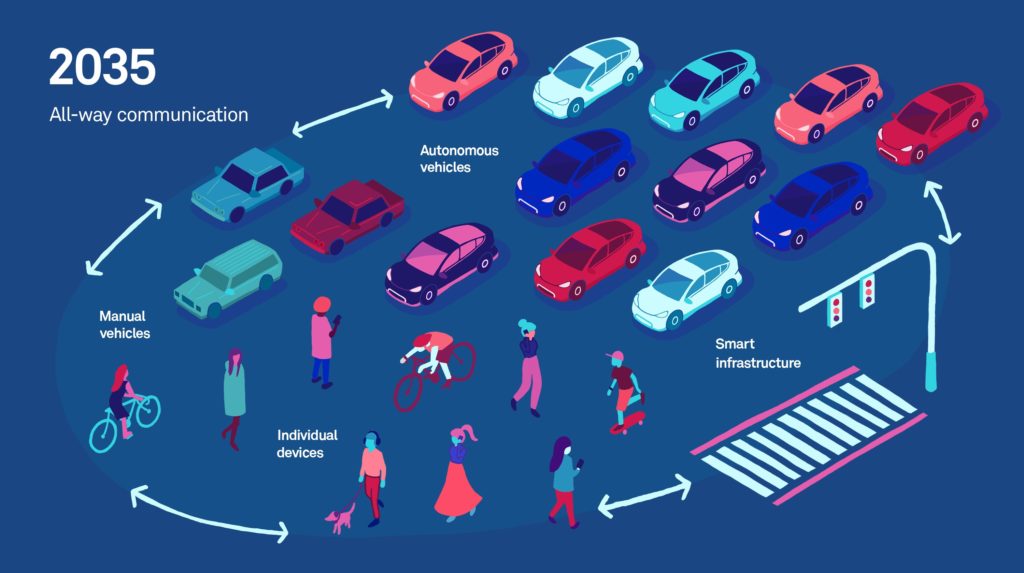
We examined how a long-term strategy could align multiple layers of devices, products, platforms, and environments to work together over the next 15-20 years and evolve as technology matures, policy advances, and infrastructure keeps pace. To illustrate this holistic approach, we envisioned how a single intersection might look in 2020, 2025, and 2035 to show how a systems-level strategy for autonomous vehicles would lead to safer outcomes for people, business, and society.
2020: Improved reaction
Within a few years, semi-autonomous vehicles will be able drive themselves in stable traffic and intervene if human drivers encounter dangerous situations. At a typical intersection, imagine that a pedestrian named Cassie absentmindedly strolls through a crosswalk during a red light because she’s focused on her phone. Driving along in his semi-autonomous car, Mike doesn’t see Cassie because it’s dark outside. Fortunately, Mike’s car detects Cassie in its path and self-brakes to avoid hitting her. At the same time, the corner streetlight senses Cassie illegally crossing the street. It illuminates the crosswalk more brightly and flashes warning colors to alert oncoming drivers. Cassie notices the warning illumination, looks up and sees Mike’s approaching car, and scurries back onto the sidewalk. In this situation, improved sensing systems and coordinated response are the first step toward an integrated system.
2025: Co-ordinated response
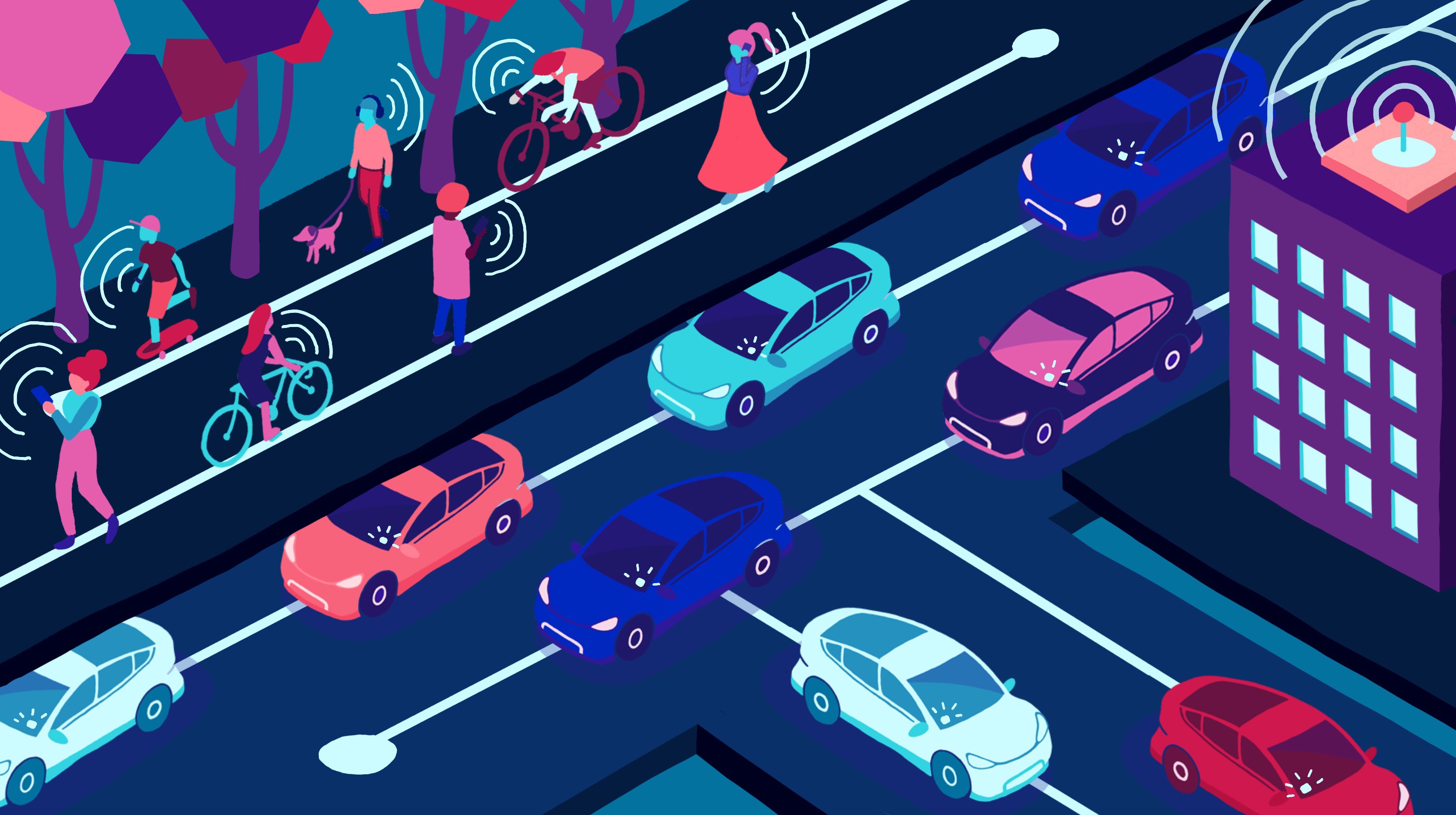
By 2025, autonomous vehicles that can drive themselves in most urban environments will share the road with both semi-autonomous and manual vehicles. While it will take some time to adjust to new driving customs and right-of-way, connectivity and regulation will help to lower the risk of collision. In this scenario, Cassie on her way to happy hour with friends. Having learned nothing from her near miss in 2020, Cassie is about to jaywalk during a red light and doesn’t notice the self-driving car that has turned into her path. Fortunately, the self-driving car is adhering to automatic speed limits and is traveling at a lower legal speed than manual vehicles and has enough time to detect Cassie. The car also pings an alert to Cassie’s phone, which instantly rings and replaces her messaging app with a warning screen. Noticing the warning, Cassie does not walk into the street with oncoming traffic. Through two-way communication, the self-driving car and Cassie’s personal device work in tandem to avert a collision. Here, greater degrees of connectivity between multiple devices and platforms increase the fidelity and performance of the system.
2035: Automated prevention
By 2035, public and private organizations will partner to fundamentally change the way we move about in cities. They will leverage data to reshape our urban environments, including separate zones and traffic rules for autonomous vehicles, pedestrians, and other modes of transportation. This time, Cassie is running late to a meeting and decides to cross a vehicle-only street to get to her destination. The first oncoming car triangulates Cassie’s movements by tracking her personal device. It predicts that she will soon be in its path and immediately stops. To avoid getting rear-ended, the car transmits a warning to all other self-driving cars on the street, directing them to slow down. At the same time, cars that are about to enter the street are re-routed by the city infrastructure to avoid congestion. Cassie eventually crosses the street, but does receive a ticket for her traffic violation and vows to do better in the future. In this phase of development, near-universal connectivity and integrated infrastructure will allow self-driving cars and cities to predict and mitigate potential risks, influencing behavior and creating preferable outcomes.
To enable this future, there will need to be significant alignment and collaboration between corporations, government, and society to ensure that our collective interests are prioritized over any single platform, product or technology. The journey begins now, while the technology is in its formative state, and before today’s decisions become tomorrow’s standards.
For anyone doubting that AI is here, the New York Times recently reported that Carnegie Mellon University plans to create a research center that focuses on the ethics of artificial intelligence. Harvard Business Review started laying the foundation for what it means for management, and CNBC started analyzing promising AI stocks. I made the relatively optimistic case that design in the short term is safe from AI because good design demands creative and social intelligence.
But this short-term positive outlook did not alleviate all of my concerns. This year, my daughter started college, pursuing a degree in interaction design. As I began to explore how AI would affect design, I started wondering what advice I would give my daughter and a generation of future designers to help them not only be relevant, but thrive in the future AI world.
Here is what I think they should expect and be prepared for in 2025.
Everyone will be a designer
Today, most design jobs are defined by creative and social intelligence. These skill sets require empathy, problem framing, creative problem solving, negotiation, and persuasion. The first impact of AI will be that more and more non-designers develop their creativity and social intelligence skills to bolster their employability. In fact, in the Harvard Business Review article I mentioned above, advice #4 to managers is to act more like designers.
The implication for designers is that more than just the traditional creative occupations will be trained to use “design thinking” techniques to do their work. Designers will no longer hold a monopoly (if that were ever true) on being the most “creative” people in the room. To stay competitive, more designers will need additional knowledge and expertise to contribute in multidisciplinary contexts, perhaps leading to increasingly exotic specializations. You can imagine a classroom, where an instructor trained in design thinking is constantly testing new interaction frameworks to improve learning. Or a designer/hospital administrator who is tasked with rethinking the inpatient experience to optimize it for efficiency, ease of use, and better health outcomes. We’re already seeing this trend emerge—the Seattle mayor’s office has created an innovation team to find solutions to Seattle’s most immediate issues and concerns. The team embraces human-centered design as a philosophy, and includes designers and design strategists.
Stanford’s d.school has been developing the creative intelligence of non-traditionally trained designers for over a decade. And new programs like MIT’s Integrated Design and Management program are also emerging. Even medical schools are starting to train future physicians in design thinking. This speaks to design’s broader relevance, but also to a new opportunity for educators across disciplines to include creative intelligence training and human-centered design in their curricula.
Designers as curators, not creators
I already wrote about how tools like Autodesk Dreamcatcher use algorithmic techniques to provide designers with a more abstracted interface for creation. Given sufficient high-level direction, constraints, goals, and a problem to solve, these tools can spit out hundreds of variations of a design, leaving designers to pick their favorites or keep re-mixing them until they get closer to a great design.
The implications of this vary across design disciplines. In architecture, the parametric movement dubbed Parametricism 2.0 demonstrates the potential of technologically enhanced creativity. Its implications are already being explored in the gaming industry, as we design virtual environments and large virtual cities. Just take a look at the game No Man’s Sky—it relies on a procedurally generated deterministic open universe, which includes over 18 quintillion (1.81019) planets. While No Man’s Sky was unsuccessful as a game, it shows the direction that eventually will come to dominate virtual content development—the designer’s role will be to set the goals, parameters, and constraints, and then review and fine-tune the AI-generated designs.
Generative design techniques aren’t especially new, but deep reinforcement learning is a relatively new technique that emerged in the last three to four years and is responsible for much of the recent excitement and progress of AI as a discipline. Google’s DeepMind created an artificial intelligence program called Deep Q, which uses deep reinforcement learning to play Atari games and improve itself over time, eventually acquiring amazing skills like discovering unknown loopholes in the games.
The real breakthrough with DeepMind’s Deep Q, and its successor AlphaGo—the computer program that plays the board game Go—is that the AI doesn’t have any domain knowledge or expertise in game play. And it doesn’t even need someone to codify the rules of how to play. It just has visual input, controls, and an objective of trying to maximize its score. To that extent, games are an ideal test environment for artificial intelligence to learn.
But what about design? That’s where the curator role comes in. In the future, designers will train their AI tools to solve design problems by creating models based on their preferences.
For instance, after years of working in the health care space, Artefact has developed a deep and broad perspective on the key issues in digital health design necessary for changing patient behaviors. I can imagine a time when we will have enough data to enter behavior goals and ask the AI system to design a solution framework that overcomes anticipated issues like confirmation bias and the empathy gap.
The ongoing era of superstar designers
As AI-driven parametric design enables designers to quickly and easily create millions of variations of a design, most designers’ productivity will dramatically increase. Suddenly, we’ll be able to explore massive numbers of alternative directions in a fraction of the time we need today. With increased productivity and better tools, it will be easier for amateur designers to create acceptable—if not exceptional—work, and potentially put price pressure on professional design services.
But while the barriers to learning and mastering the craft will be lower, the design industry’s superstars will most likely remain unaffected. We saw a similar trend in print and graphic design in the 90s. The arrival of desktop publishing software ultimately eliminated the lower end of the market. But it also created broader appreciation for design from everyone, increasing the demand and the differentiation for the very best designers. Until AI is capable of surprising us with completely novel ideas, superstar designers and companies that invest in them will continue to dominate, increasing the value of design brands.
From traditional to virtual designers
A cynic might say that, as a massive number of people lose their jobs to AI-powered automation, they would escape in a virtual reality world, powering a growing demand for virtual worlds, objects, and experiences. Hopefully, we can avoid this dystopian scenario, but as virtual, augmented, and mixed reality explodes, it will become the next frontier of opportunity for design. Challenges like how we interact with each other in virtual reality and how we create and communicate shared experiences are not only unique for this new medium, but require skills such as creative and social intelligence that are hard to outsource to AI.
In addition, virtual worlds may generate new demand for the more traditional design disciplines, such as architecture, interior design, object design, and fashion, as we rush to create virtual worlds.
Designing AI, designing humanity
By framing the argument to show how AI is stealing our design jobs, I’ve perhaps done a disservice to AI’s contributions to the design profession. When humans and computers work together, they can do amazing things that neither could do alone—just take a look at Michael Hansmeyer’s unimaginable shapes. With their millions of facets, these forms cannot be built by a human alone, yet they can redefine architecture.
While this is just one example, there is something undeniably appealing about finding ways to amplify our creativity as individuals and across professions. I can see the potential for a future where our personal AI assistants, armed with a deep understanding of our influences, heroes, and inspirations, constantly critique our work, suggesting ideas and areas of improvement. A world where problem-solving bots help us see a problem from a variety of perspectives, through different frameworks. Where simulated users test things we’ve designed to see how they will perform in a variety of contexts and suggest improvements, before anything is even built. Where A/B testing bots are constantly looking for ways to suggest minor performance optimizations to our design work.
Far from threatening the design occupation, AI offers a huge opportunity for design, especially for those involved in designing the interactions we have with the emerging AI systems. How do we design those AI design tools? How will we design the intelligent services and platforms of our future? How should we design these systems in a way that helps us augment our creativity, our relationships with the world, our humanity?
That is a tall order and an exciting opportunity for us and for the generations to come.
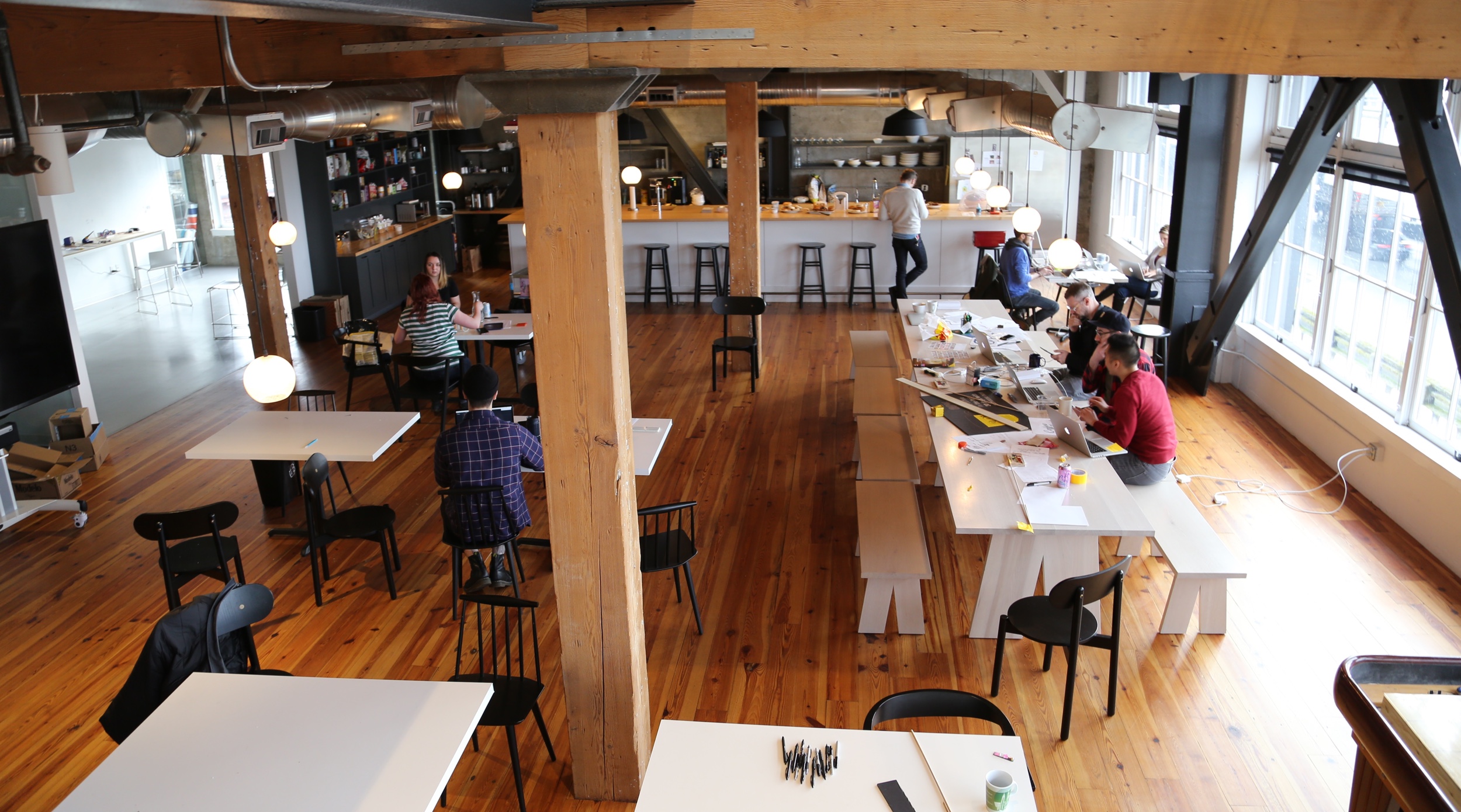
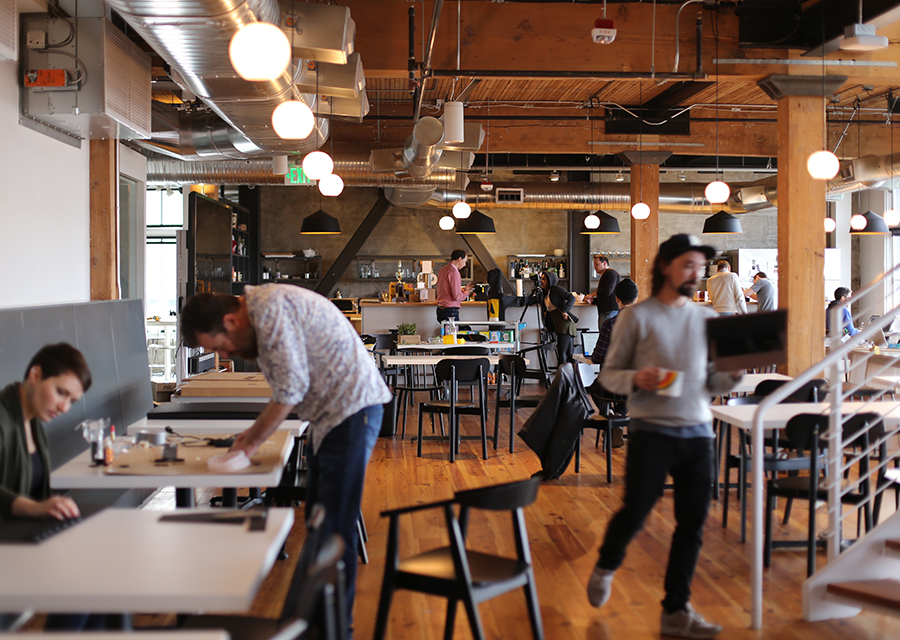
Artefact’s first official hackathon was a whirlwind of coding, prototyping, and plenty of duct taping. In 24 hours, 60 Artefact employees worked around the clock to create 13 different products with one theme: making Artefact the best place to work. Needless to say, it was a huge success and lot of fun (Not to mention a giant mess.)
Some teams took the high-tech approach and hacked together Arduinos, motion sensing cameras, Raspberry Pi, Amazon Alexa, and Slackbots to design office improvements. Team Spicy Pork created The Bar Cam, a connected camera that uses sound and an Amazon Echo Dot to trigger photos and time lapse video of happy hour and then notifies the office of what’s happening in the kitchen via Slack integration. Thanks to Team District 13, our front desk now has a smart piggy bank that senses donations and uses an Amazon Echo Dot to report where contributions will make a difference.
Voice commands were a big theme in many of the projects, so much so during judging, commands to one Alexa often set off several submissions at once!
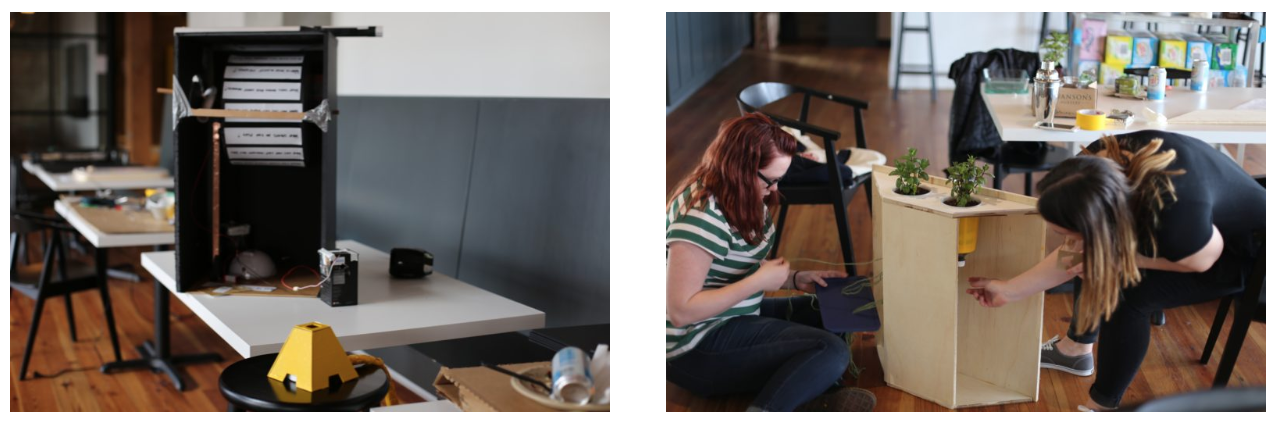
Other teams kept it analog and old school by blending design solutions with everyday items. The kitchen dishwashers now have a 3D printed sign that indicates whether they should be emptied or filled, and one team created a self-watering garden of mint which will take our mojito game to the next level. Using cardboard, pipes and wood, Team Lucky Lunch created a working slot machine that pairs people off for lunch and even makes the mechanical “click-click-click” sound that makes playing the slot machine so satisfying.
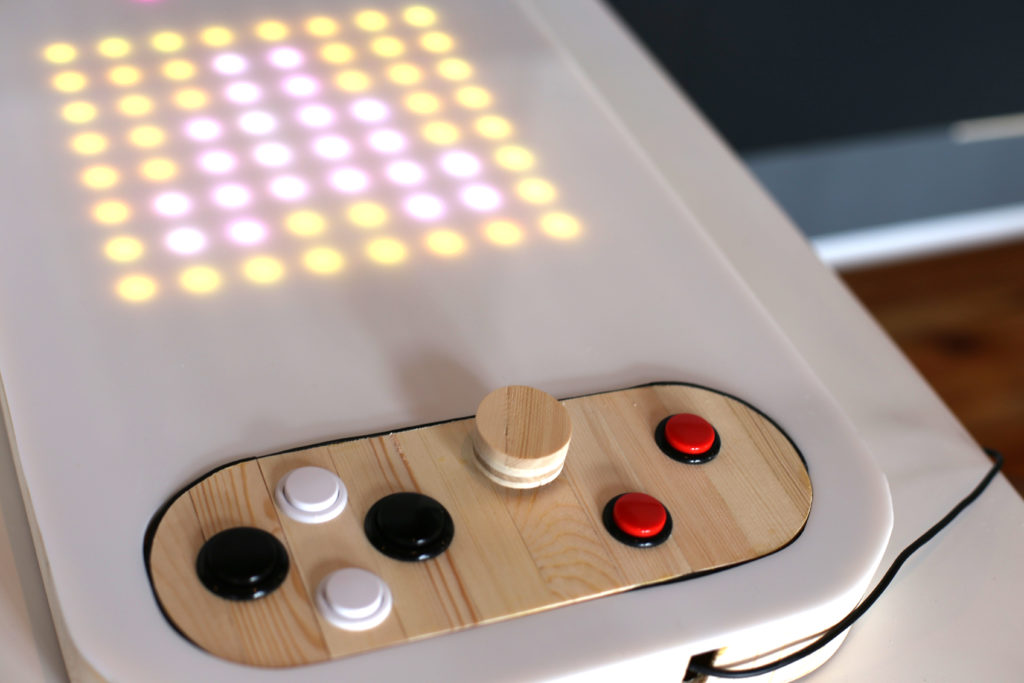
Like the Lucky Lunch submission, many of the projects created during Artehack ’17 focused on helping employees connect with each other, carve out time for new relationships and get to know one another outside of the normal project teams. Using NFC stickers, poker chips and even a few mousetraps, our shuffleboard table has been transformed into a game called Coffee Time that pairs people together for grabbing an afternoon espresso. Near our elevators, Project Lunch Buddy is a set of old airplane seats typically used for travel prototyping that have now been rigged to light up when someone wants to go to lunch. One team even created our own Artefact Slackbot named Artie, who starts threads between random employees and sparks conversations with icebreakers.
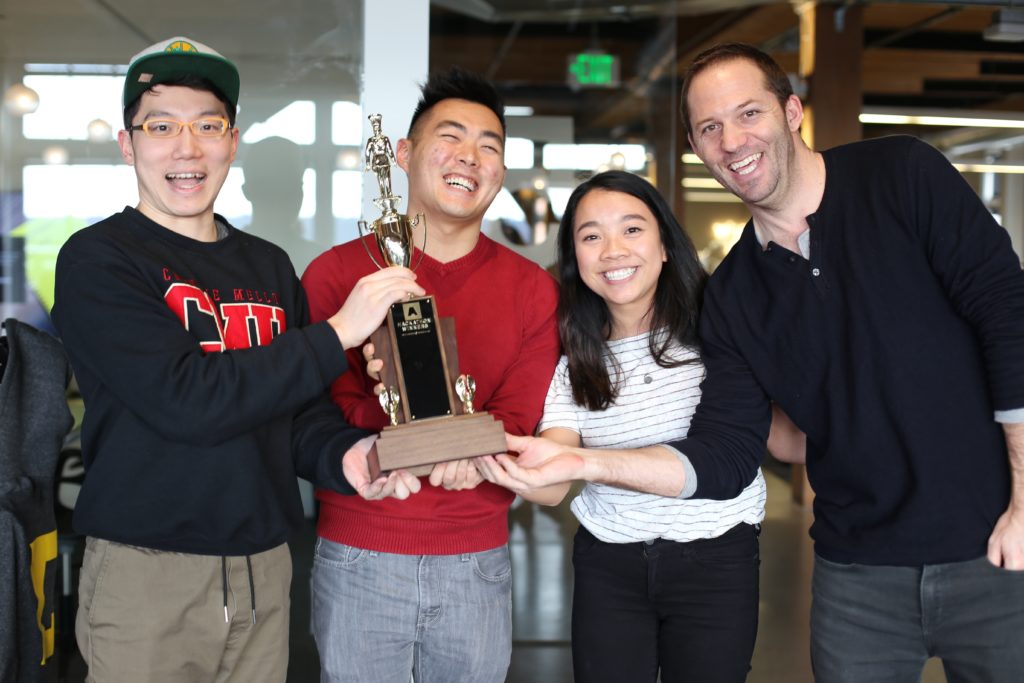
After the dust settled and the submissions were judged, one team emerged victorious. Staying true to the prevailing theme of creating connections and building relationships, Jackson, Felix, Kris and Michael created an Alexa-enabled trivia game called ArteFacts. Start the game, and Alexa will ask you trivia questions about the people of Artefact.
Amazing projects aside, the true measure of our first Artefact Hackathon was seeing all of our people band together, get their hands dirty, and apply their passion for design and tech to improving our studio. Based on the amount of fun we had, Artefact is already a pretty exceptional place to work—minimal hacking required.
For the second year in a row and third time in four years, we’re thrilled to announce Artefact made Seattle Business Magazine’s Best Place to Work list! Making this list each year is becoming more and more competitive, but the competition only drives us to raise our bar so we can continue to better serve our employees, clients, and community.
Each year, we reflect on things that are going well and focus on areas needing improvement in the studio and in client work. We frequently ask our employees and clients for feedback and hold ourselves accountable to make changes to the areas that need to evolve. We understand, that in order to be prosperous as an organization, it is essential to take the time to listen to this feedback and act on it. The 100 Best Companies List means a lot to us because it is driven and determined completely by employee feedback, so to make it on the list means our employees are speaking up and sharing what they love about working at Artefact.
It is truly an honor to receive this recognition. This year, instead of writing about Artefact, we wanted employees to speak for themselves and share why they love working here:
I love Artefact because (just as with our client work) people are at the center of everything we do. I’m supported through mentorship, empowered to grow professionally and contribute to my community, and connected to my colleagues in fun and meaningful ways. We get to tackle interesting and diverse projects, and I’m especially proud of the work we do for social good and underserved communities.
Joan Stoeckle, Design
I like that Artefact is a small company that always tries to figure out how to change for the better. Most companies resist change until it becomes too late, but Artefact is always hacking itself. I’ve been at a lot of companies and this is the only one that I’ve worked at that is serious about self-analysis and growth. It’s truly a learning organization.
Sheryl Cababa, Design
Artefact attracts great projects and the amazing talent who want to change the world, learn from each other, elevate themselves and those around them. The company itself is an exercise in great user experience, looking at pain points and iterating our approach to create a culture where you can do your best work.
Jon Mann, Design
Artefact consists of a group of skilled, passionate, inspiring, well rounded individuals that are always motivated to learn from each other and have an impact in the community. We yearn for the challenge to craft amazing things and we look for opportunities to design for a better future. What makes us stand out from other organizations is that we genuinely care and respect each other. As an organization, we do all we can to support each other through career and life obstacles. We create opportunities and provide the right tools for our employees to thrive as consultants. The key to Artefact’s success is our people and we don’t take any of our talent for granted. We value the unique aspect each individual brings to the table, and together, we’re a stronger company for it.
The word robot was coined by Czech author Karel Čapek, who used it in his 1921 play R.U.R. to describe a fleet of intelligent machines. He named his invention based on the Slavonic word “rabota,” which means labor. More tellingly, rabota is also the root of the word “rob” or slave. And in fact, automation promises to get away with some of the most tedious, repetitive tasks we love to hate.
Take telemarketing for example, one of the most slave-like occupations in the 21st Century. I think, it is safe to assume that no one has ever dreamt of a career in telemarketing or would miss it if it were to disappear. Luckily for us, it is the job most likely to disappear, according to Carl Benedikt Frey’s and Michael A. Osborne’s excellent study The Future of Employment: How Susceptible Are Jobs to Computerization. They examined some 702 occupations and evaluated the level of risk for each one of them.
The extensive list and ranking is interesting in an of itself (you may want to consider a career in recreational therapy. Whatever that is — it is least threatened.) More importantly, the study identifies three factors that impact that level of risk, allowing us to start thinking about how automation will impact our own specific fields. These three criteria are: perception and manipulation, creative intelligence, and social intelligence. I’ve added to that framework the concept of predictability. In a nutshell, the occupations that are most likely to resist automation would:
1. involve complex perception and manipulation activities,
2. require the ability to come up with clever ideas, or new ways of solving problems,
3. involve negotiation, persuasion, empathy and caring,
4. demand the individual to be highly adaptable to different contexts and situations
My interest is not only in exploring the topic of automation broadly, but looking at how these apply to various design professions. A quick examination of the above list and you might think that since that sounds a lot like a designer’s skill set, you must be safe. The reality is a bit more complex, so let’s take a look at each factors and relate it back to design professions specifically.
Perception and manipulation
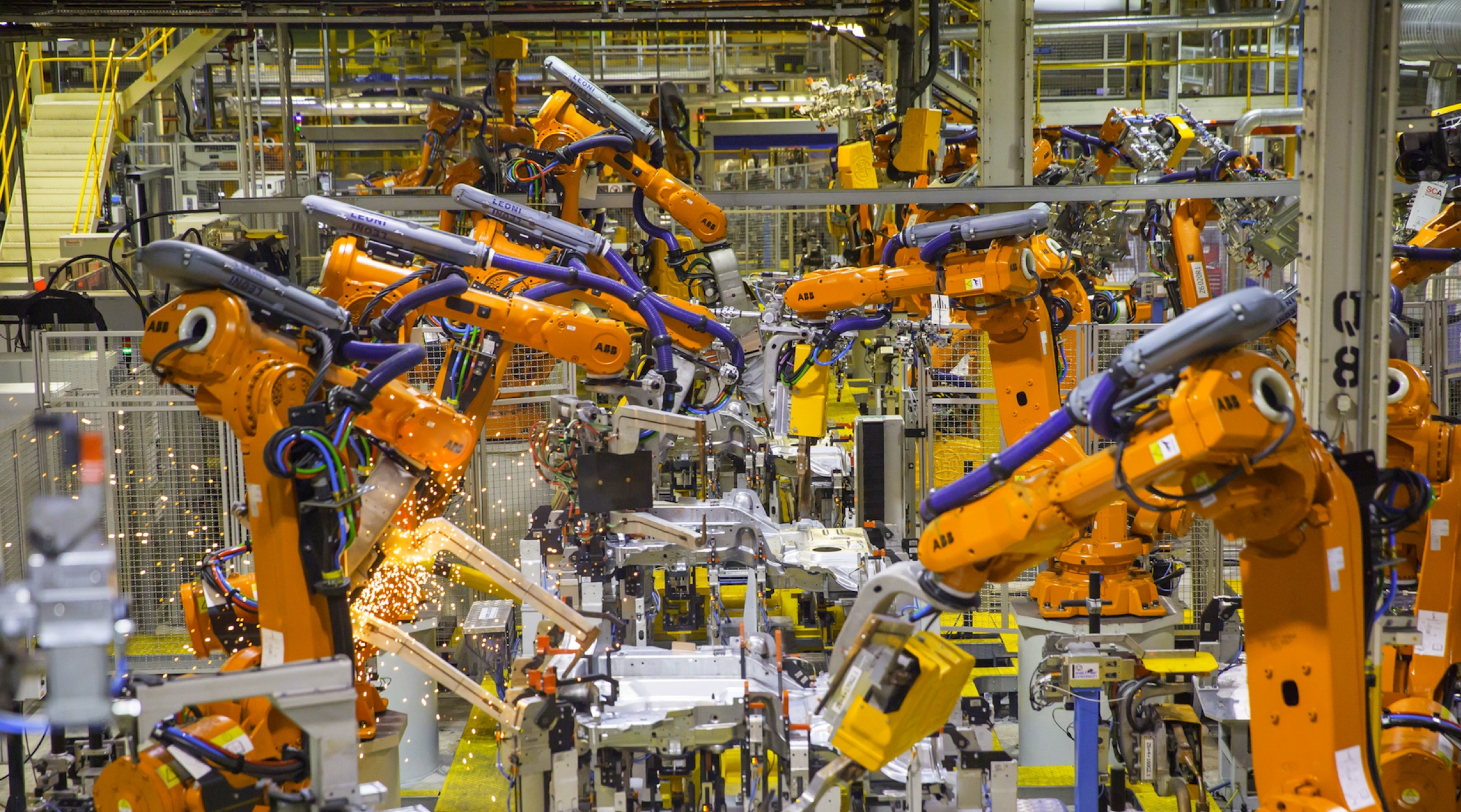
This class of automation challenges begins with perception systems mostly related to 2D computer vision and 3D spatial sensing technologies — for example, jobs that involve simply recognizing objects or aspects of objects through jobs that involve lots of fine finger dexterity or precise manipulation of small irregular objects. At a higher level, manual dexterity tasks combine the challenges of micro-manipulation with broader physical movements, like opening a door, climbing stairs, or stacking a set of boxes. If you combine these two tasks and add in the challenge of working in tight physical spaces, then you have a job that is highly resilient to displacement. Plumbing is one such example. Another, less obvious one is car assembly lines — while huge robotic equipment seems to do most of the work, you still see humans doing various micro-manipulation tasks inside the cramped, half-built vehicles.
For designers, visual perception is a critical skill and for those crafting 3D objects, so is spatial manipulation. So you might quickly conclude that if computers aren’t yet good at these things then we are safe, and you’d be partly right. Yet in the last few years, computer vision and deep learning systems have been deconstructing massive datasets of 2D images and 3D objects, working to inform a algorithmic designer as to ways to manipulate compositions, form, texture, etc.
Take the Prisma app, for example — our Sunday night dinners and backyard parties can suddenly look like a Van Gough masterpiece, not by design, but by data. Tools like that will disrupt the illustration profession, potentially reducing hours of laborious craft into software processing that spits out image compositions of any objects, in any art style.
In web page design we have the controversial (at least in the design community) Grid.io, which in some cases appears to do photographic and typographic composition based on high level parameters set by the designer. The combination of deep learning systems with simple codified heuristics, rules, best practices and principles means that many of the perceptual activities that a human designer thinks of as their idiosyncratic “eye and craft,” will be replaceable by AI systems sooner or later.
As for 3D manipulation, 3D printing techniques are making it possible to create physical objects far beyond the capability of even the best human craftsman.
Creative intelligence
The second area that is hard for AI technologies is creative intelligence. This is the ability to come up with valuable ideas and figure out ways to solve different kinds of problems.
In a recent piece, I shared thoughts on the nature of creativity, or the ability to create ideas or artifacts that are novel and valuable. By dividing creativity this way, it becomes clear that ascribing value (in the broadest sense) to an idea is fundamentally a subjective assessment. Value changes in context, culture across time, and with different individual identities and personalities. It’s why attitudes and preferences for art, music, fashion, vary so greatly.
In design, a valuable or clever idea may also be the result of a particular insight or perspective on behalf of the team. That breakthrough may result from rigorous research and understanding, or simply from social perspective, philosophical bias or what is commonly identified as individual “genius” or “talent.” Ideas are extremely resistant to codification. In their early form they are slippery, elusive and often feel good for seemingly emotional reasons. As many design thinkers have reflected, great design is as much about the hunt for the perfect framing question, as it is about coming up with a valuable answer, which makes the challenge of codifying valuable ideation even tougher.
Advances in overall computing power have made simulation possible so that similar parameter driven designs for objects and buildings can be created and millions of variations evolved to find the optimal engineering tradeoffs. This has been termed Generative design, and its been around for 30 or so years in various research facilities. Autodesk Dreamcatcher has been on the forefront of demonstrating the early proof of concept of this idea.
Tools like Dreamcatcher make creating novel solutions, an aspect of creative intelligence, highly susceptible to automation. Especially in the visual realm, there are many known techniques that can be applied to the creation of novelty. Computers armed with a reasonable understanding of goals can simply create massive numbers of design variations, remixing content, techniques, principles and patterns infinitely. They can also analyze the technique and emulate it, when sufficient example data exists.
Focusing only on creating novelty, however, is fake creative intelligence. While machine intelligences will be an increasingly powerful tool, it seems hard to imagine computers spontaneously challenging themselves with creative questions, generating creative solutions and evaluating the value of those solutions to find something optimal. To quote Picasso “[Computers] but they are useless. They can only give you answers.” Something that is perhaps inherently human is the ability to formulate the right question.
Social intelligence
Social intelligence is about real time recognition of human emotions. It poses a hard to overcome set of problems related to the complexity of codifying human social, cultural and emotional behavior. Codifying “common sense” and how senses and experience inform an awareness of the dynamics of situations, emotions, behaviors and contexts is hard to program. Examples range from the most basic kinds of understanding and prediction of physical interactions, like playing Jenga, to subtle cultural norms, like etiquette, politeness, taboo, political correctness. It also spans understanding human intent, motivations, emotions and actions. From an engineering perspective, these are all discrete and difficult challenges.
One relevant test of computers’ ability to do this is the Turing Test. Devised by Alan Turing in 1950, it was intended to test progress in AI technology to see if computers could fool a human into thinking it was communicating with another human in text based communications. In 2014, in an annual Turing Test, Eugene Goostman, a chatbot pretending to be a 13 year old Ukrainian boy, convinced a third of the judges that it was a real human. (Since Eugene claimed he was a tween, with English his second language, he was able to slide by with some communication wrinkles.)
Yet, despite the progress that is being made, jobs that require high social intelligence, like public relations, acting, comedy writing seem unlikely to be replaced by automation in the near future.
Similarly, social intelligence is at the core of human centered design. Most designers would agree that great designers possess high social intelligence, and a great understanding of culture and humanity. Furthermore, as we are called on to design for richer cross-disciplinary contexts, we are almost constantly in a state of negotiation and persuasion.
Predictability
Predictable tasks are not just those that are repeated in some endless process loop. If your job is something that can be broken down into a flow chart, with a series of decisions and actions from start to finish, then your job is potentially highly susceptible to automation. As long as the nature of the decision-making and action in each step doesn’t involve complex perception and manipulation, creative intelligence, or social intelligence, automation is probably right around the corner.
Take for example an autonomous car navigating through city traffic, from one destination to another. On the surface, this would appear to be highly complex in terms of predictability. However, from a logic perspective, this problem is more solvable. There is a clear path-finding problem to solve (how to get there using detailed maps of roads), there are unambiguous rules of the road and there are easily measurable environmental obstacles to recognize, understand and react to. Only this last category — the perception and reaction to environmental obstacles — involves complex perception activities. At a complex intersection with multiple lanes, pedestrians, bike lanes, even random debris, traffic signals, things obscured by other vehicles — the perception challenge is quite formidable. To make matters more technically complex, the system must not just be “locating” the positions of these things but “predicting” the movement of these objects relative to the physics of the vehicle. Whilst this sounds and is daunting, the basic decision making and actions the car has to operate by are still very simple — try to avoid hitting anything whilst obeying the rules of the road, and getting the car from A-B.
Different design professions are rooted in different traditions and different degrees of adherence to elaborate creative processes and more systematic, predictable methods. On one hand, many design professions can be broken into a series of steps. On the other, it’s the content of each of the decision-making steps that determines the degree of susceptibility to automation. If we examine brainstorming, one step that we use in almost every design process, we can see the important role creative and social intelligence play and how they make predictability virtually impossible.
Competing with the machines: Can we win the battle?
Of the four criteria, social intelligence and creative Intelligence stand out as the most difficult areas for computer science researchers to make near term progress that would be good enough to displace significant numbers of jobs in the 5–15 year timeframe.
Entrepreneurs (and designers) in the AI field are busy right now hunting for parts of occupations or whole occupations that have relatively straightforward predictability scenarios. There are hundreds of examples of jobs that look highly susceptible to displacement from secretarial positions to tax preparation, insurance policy clerks, insurance underwriters, data entry clerks, loan officers, credit analysts, book keeping accounting, shipping and receiving clerks, office administrators and hundreds more. Over the next ten years we will increasingly feel the impact of this work as we witness somewhat unprecedented occupation displacement through increasing automation and robotics.
While there are attempts to automate certain perceptual and novelty aspects of creativity and design, for the next few decades, I think we can conclude that most design professions are probably reasonably safe from computerization. But before we exhale a collective sigh of relief, let’s be realistic — our professions are going to be deeply impacted by AI.
Smart cities cycle: Building bike culture with behavioral economics
May was Bike to Work Month at Artefact, and together we pedaled nearly 500 miles commuting to and from the office. Bike to Work Month is always exciting because so many people at Artefact are passionate about cycling: Sheryl brought her beloved Dutch bike when she moved from Amsterdam, and Holger even builds his own bikes. In May, I took a trip to Amsterdam and Copenhagen to experience the cycling culture and infrastructure in both cities firsthand (as well as eat a million stroopwafels, mission accomplished).
Somehow during all of my time in Amsterdam and Copenhagen, I did not get a single photo of me actually riding a bicycle. I did, however, get this photo hugging a cat in a bicycle rental shop. (His name was Chris, he was wonderful.) Just take my word for it, I rode a bike a lot.
Our passion for bikes goes beyond the personal. For cities looking to solve community issues with smart solutions, it’s hard to imagine a single product that comes as close to being a silver bullet for smart cities than bicycles. The benefits are clear: investments in cycling reduce car congestion and improve public health, thanks to the increase in exercise and decrease in air pollution and automobile accidents. Cycle-centric cities are not only safer, but they make cities more accessible for people from all economic levels and connect communities rather than divide with highways.
We know that choosing to prioritize cyclists the way we prioritize cars and pedestrians can fundamentally shape a city for the better. In the 1960s, Copenhagen made proactive choices to design roadways and communities to encourage safe cycling, and today the city reaps the rewards of putting cyclists first. Fifty percent of all Copenhagen residents commute by bicycle, and the city has been deemed the World’s Most Bike-Friendly City and the World’s Most Livable City— and the connection between the two is no coincidence.
A famous example of cycling infrastructure, the Cykelslangen (“Bike Snake”) Bridge in Copenhagen. Photo credit: Danish Architecture Center.
Becoming a world class cycling city like Copenhagen requires extensive urban planning and investment in significant cycling infrastructure. But as many cities look to smart solutions to improve their communities, there are achievable and incremental actions cities can take today to build a cycling culture that will support a smart city ecosystem.
Behavioral economics for bicycles
At Artefact, we often deploy “behavioral nudges” in our design work— subtle suggestions that direct people toward taking positive or preferred actions. Building a network of bike lanes takes time, but cities can apply behavioral economics to their existing infrastructure today in order to nudge citizens towards cycling.
Cities all over the world are implementing low-tech, low-investment behavioral nudges to increase ridership. Many start with creating space for cyclists in small ways, such as adding secure bike parking at key destinations like grocery stores and ensuring that buses, trains and other transit options have designated space for cyclists to stash their bikes. In Copenhagen, I experienced another behavioral nudge: the bike footrest. The city installed simple, inexpensive railings at intersections so that cyclists have a place to lean while waiting for the light to change. Taken together, all of these are smart behavioral nudges and minor adjustments that encourage more riders and good cycling behaviors.
Behavioral nudges can also be baked into bike share programs to increase their success rates. The city of Hangzhou, China made the first hour of bike share rental free to attract users. On my trip, I preferred using a specific bike share because it used Bluetooth-enabled locks that made grabbing a bike as simple as clicking a button on my phone. Also, as we have learned from my photo, incorporating a cat named Chris into your bike rental shop is an excellent behavioral nudge for encouraging me, specifically, to ride a bike in your city.
Build support with behavioral economics
For any city, moving toward a more cycle-friendly future requires extensive community support and coalition building. We can use the concept of behavioral nudges not just to attract cyclists, but bring businesses and stakeholders along for the ride as well.
The story of the Hackney parklet is an excellent example of incentivizing the support of cycling for the broader community. The London Borough of Hackney commissioned the creation of small, movable mini-park that created a temporary sanctuary for cyclists and could be moved to outside different businesses. With protected seating and parking for bikes, the parklet was an attraction that helped bring more in more sales for participating businesses, rewarding them for promoting cycling.
For cities with a growing cycling culture, an unfortunate friction can crop up between car commuters and cycling commuters. With behavioral economics, we can make cycling a part of city commuting and encourage the car-and-transit populations to incorporate cycling into their routine. The city of York, England made small upgrades to existing infrastructure to increase cycling among commuters. With the “Park and Pedal” program, York created space at their existing park-and-ride facilities for bicycles, which shortened long bike commutes, allowed people to securely store their bikes overnight, and promoted biking within the city center.
The Hackney parklet, a quick-build installation that attracts business by creating space for pedestrians and cyclists. Photo credit Get Britain Cycling.
Rapid prototyping for bike infrastructure
We’ve talked about using behavioral nudges to encourage cycling, but there’s another way cities can experiment with bike infrastructure using a design method: rapid prototyping. Several cities, including Seattle, have had tremendous success with quick-build, rapidly iterated tweaks to existing streets to determine what works best for cyclists in their cities. The organization People for Bikes lays out how cities have used community input to prototype spaces for cyclists with simple paint jobs and temporary objects, then used the experimental spaces to inform more permanent cycling investments.
An example of an intersection in Chicago where cycling advocates reclaimed underutilized infrastructure to quickly experiment with bike-friendly design. Photo credit: People for Bikes.
Bikes: the ultimate tool for smart cities
The benefits of bicycles pay even more dividends for smart cities in the era of connected devices and data-based decision making. Future devices for bikes and cyclists include smart lights that prevent possible accidents, pedal-powered filters that clean air pollution, and cycle-based sensors that report traffic conditions. At Artefact, we developed a prototype called BrakePack, a smart backpack for the urban cyclist that helps reduce traffic incidents. There’s an entire new subsection of technology taking off that cities can dial into in order to improve quality of life for cyclists, drivers, and pedestrians.
As cycling continues to increase in popularity, cities should plan to include cycling technology as part of their strategy to become more smart and connected. By analyzing information gathered by cyclists and bike technology the way we do cars, cities can make more informed urban planning decisions, design effective infrastructure, and prioritize needed upgrades. In the age of IoT and artificial intelligence, the simple bicycle may be one of the most powerful and transformative tools for any smart city.